Inside the Network: Why Logistics Performance Is Now Defined by What Happens Beyond the Port
 By Hannah Kohr · Mar 26, 2026 · 3 min read
For much of the past decade, supply chain disruption has been framed through a familiar lens: ports, vessels, airspace and geopolitical chokepoints. But recent market behavior suggests a more structural shift. The constraint is no longer primarily how goods move between nodes - but how effectively those nodes themselves operate.
Freightos data shows the pattern clearly. Even as conflict-driven rerouting and fuel surcharges push air cargo rates higher and create localized congestion, large parts of the ocean market remain relatively stable. Capacity exists. The friction is uneven. What breaks down is not the network as a whole, but specific segments under strain.
That distinction is driving a change in how operators think about resilience.
In high-throughput environments, small inefficiencies now scale disproportionately. A warehouse that pauses autonomous fleets for charging cycles, a yard that relies on inconsistent manual coordination, or a facility operating without real-time inventory visibility - each becomes a multiplier of delay when upstream variability increases.
This is where a new class of solutions is positioning itself.
YMX Logistics approaches the same problem from a different angle: execution discipline. The company emphasizes that yard performance depends less on isolated technology deployments and more on consistent, standardized execution across sites. According to YMX, its Yard Operating System is designed to ensure that operational processes, safety protocols and performance standards are “precisely executed every day in the field,” particularly in complex, multi-site environments where small deviations can quickly cascade into broader delays. As congestion builds upstream, that consistency becomes a critical buffer.
The operational emphasis is also reflected at the personnel level. YMX Logistics’ Field Operations and Safety Specialist Tammy Deschler was recently named a 2026 “Top Woman to Watch in Trucking” by the Women in Trucking Association, recognition that underscores the role of on-the-ground execution in maintaining performance under pressure. Deschler’s work focuses on ensuring that yard processes, safety protocols and operational standards are consistently applied across complex environments - a reminder that even as technology advances, disciplined human execution remains central to keeping freight moving.
CaPow frames energy as a systemic constraint rather than a technical detail. “Energy delivery is one of the most overlooked constraints in automation,” said Prof. Mor Peretz, Co-Founder and CEO of CaPow. “With Power-in-Motion, robots receive energy efficiently as they operate. This changes how fleets are designed and enables automation systems to operate at their full potential.” By enabling robots to charge while in motion, the company removes one of the few remaining stop points in automated environments, allowing fleets to maintain continuous activity and reducing the need for oversized batteries and dedicated charging space.
CaPow’s move reflects a broader shift in automation strategy: from deploying robots to optimizing the full infrastructure that supports them. Alongside the advisory board expansion, the company is increasing its market visibility through active participation in industry exhibitions, including a live demonstration at MODEX 2026 (April 13–16, Atlanta), where it will showcase its Power-in-Motion™ platform at Booth A901. The demonstration features two different robotic systems - Ocado Chuck and MiR600 - operating simultaneously while receiving energy in motion over a shared modular charging pad, illustrating a multi-platform energy approach. Rather than requiring robots to stop and dock, CaPow’s Genesis system enables continuous wireless energy transfer at key workflow points such as picking stations and high-traffic paths, keeping fleets in an energy-positive state and eliminating charging downtime. The positioning is explicit: energy delivery is not a secondary constraint but a core determinant of throughput, fleet sizing, and warehouse design, with the company highlighting gains in uptime, space utilization, and operational efficiency as automation scales.
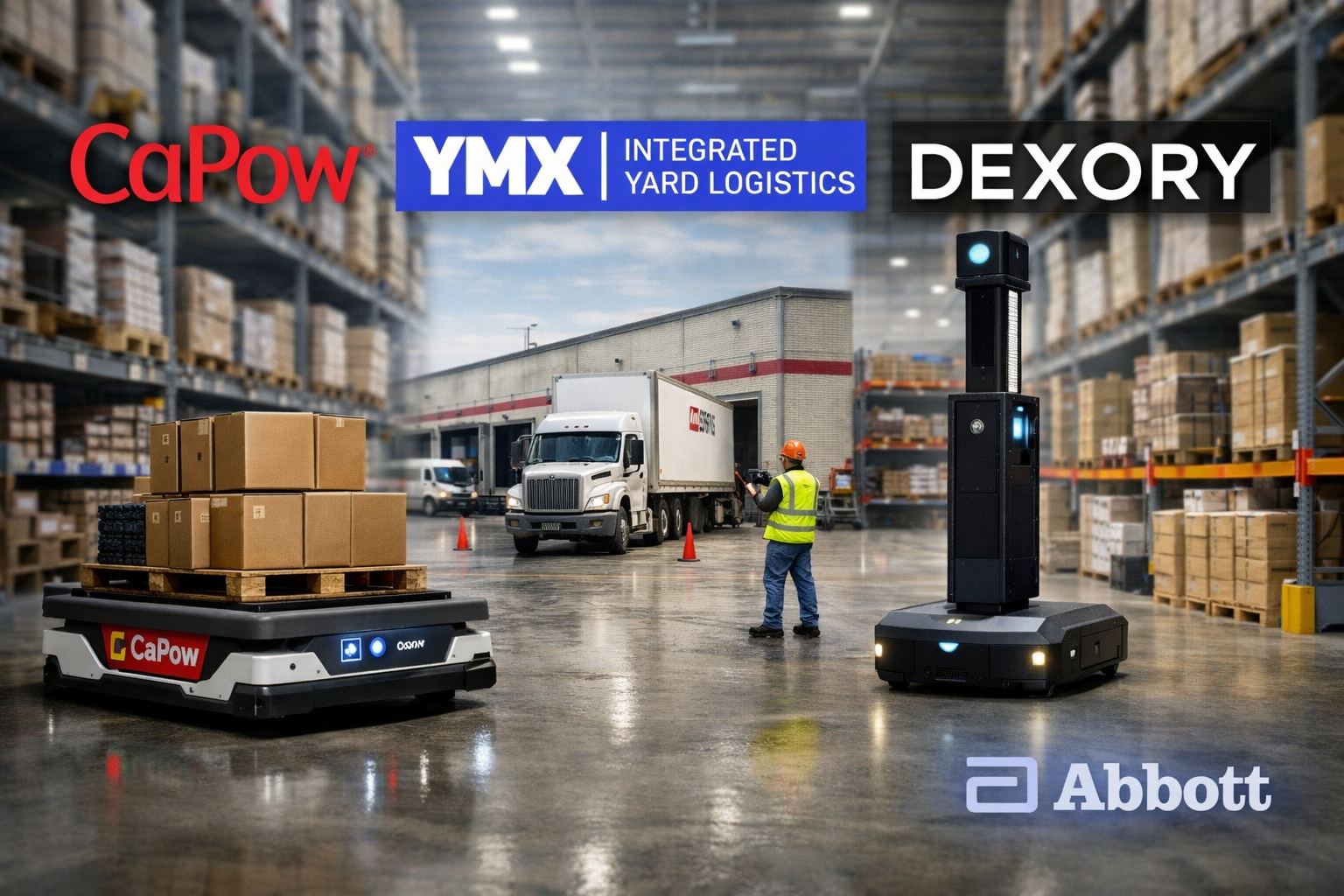
Dexory targets another blind spot: visibility. In many facilities, inventory accuracy still relies on periodic checks rather than continuous awareness. Autonomous scanning shifts that paradigm, turning inventory into a live dataset rather than a static record. The operational impact is subtle until volumes rise - then it becomes decisive.
Even at the enterprise level, the challenge is less about adopting technology than about absorbing it. In a CNBC interview, Abbott CEO Robert Ford pointed to a growing gap between pilot success and operational integration, noting that companies are struggling to scale automation without introducing new bottlenecks.
The common thread is not technology, but flow.
One logistics executive recently described the current environment as “a system that still works - until it doesn’t, and then the failure is highly localized but operationally severe.” That pattern is increasingly visible: not global breakdown, but concentrated friction where execution, infrastructure and coordination fall out of sync.
The implication is strategic. For years, resilience meant diversification - more routes, more carriers, more buffers. Today, it increasingly means precision: fewer interruptions, tighter execution, and systems designed to operate continuously under variable conditions.
In that sense, the center of gravity in supply chain performance is shifting. Not away from the network, but deeper into it.