
AI Eyes on the Warehouse - How Video Analytics Is Reshaping Logistics Operations
 By James Samuel · May 10, 2026 · 5 min read
Warehouses are rapidly becoming one of the most important environments for the deployment of video management systems VMS and AI driven analytics. What was historically a passive layer of CCTV recording for loss prevention is now evolving into an operational intelligence platform that connects cameras, analytics engines and warehouse execution systems.
Across logistics networks, distribution centers and fulfillment hubs, cameras are no longer installed simply to document incidents after they occur. Instead they increasingly function as sensors feeding real time data into operational workflows. Video analytics, facial recognition and object detection technologies are being integrated directly into warehouse environments to improve safety, reduce shrinkage, monitor processes and generate operational insights.
Warehouses Become Computer Vision Environments
Several structural trends are driving this shift. First, the scale and complexity of modern fulfillment operations has increased dramatically. E commerce fulfillment centers process thousands of orders per hour, often across multiple picking zones, automated conveyor systems and robotic fleets. Human supervisors cannot physically monitor all processes simultaneously. Video analytics provides a layer of continuous digital oversight.
Second, AI based computer vision has improved significantly in the past five years. Modern analytics systems can recognize objects, track movements, detect anomalies and correlate events across multiple cameras in real time. This allows warehouse operators to identify safety risks, workflow bottlenecks and suspicious behavior automatically.
Third, the falling cost of camera infrastructure and edge processing has made large scale deployments economically viable. Warehouses that previously installed dozens of cameras now often deploy hundreds.
In this environment, the role of the VMS platform has expanded. Traditionally, VMS software acted primarily as a control interface for camera streams and recording storage. Today it increasingly functions as the integration layer connecting cameras with analytics engines, access control systems and operational software. Industry research indicates that the global VMS market remains dominated by a relatively small group of vendors. According to analyst firm Omdia, Genetec continues to hold the number one position globally in video surveillance software and also ranks first in the broader category combining video surveillance software and Video Surveillance as a Service VSaaS.
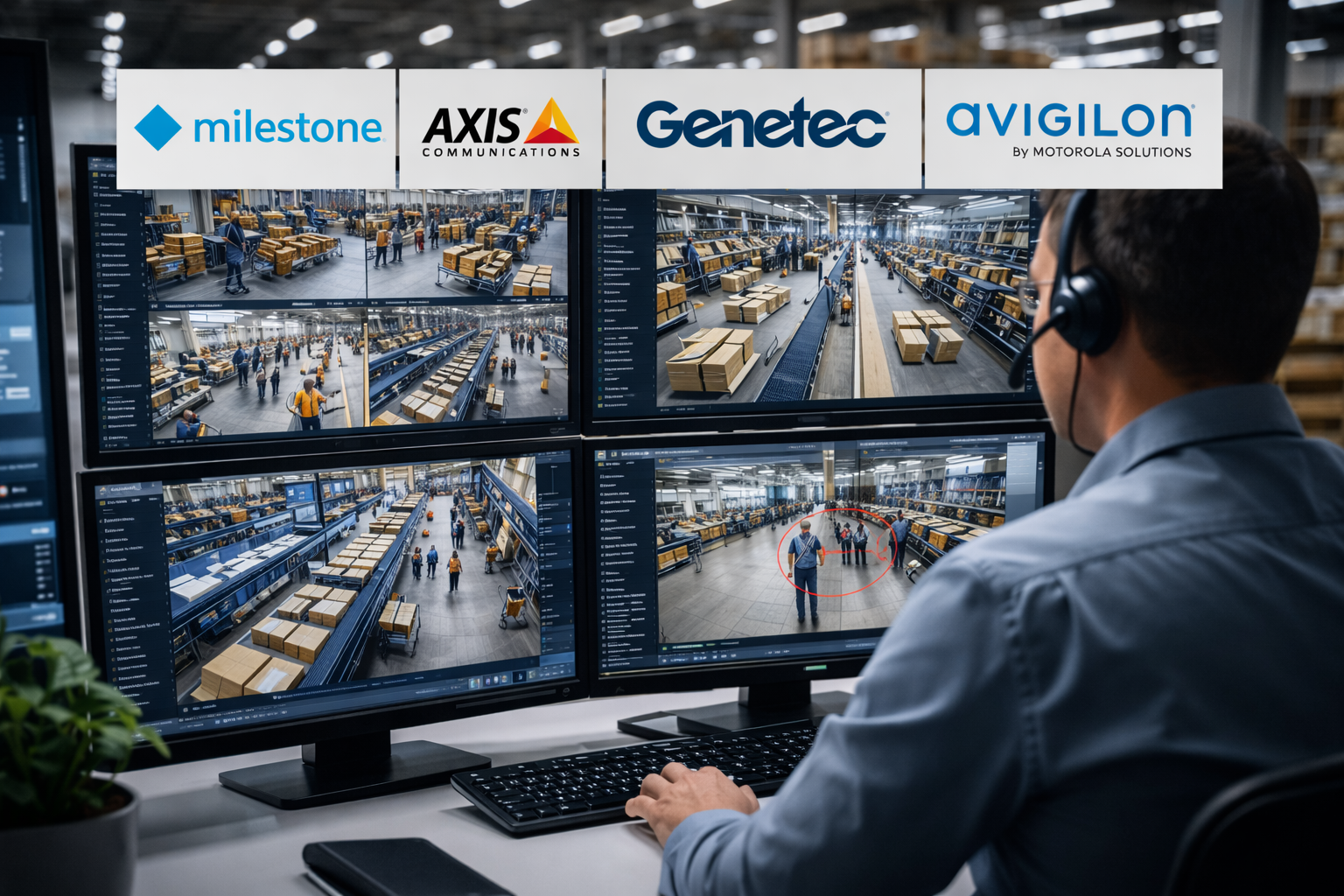
Other major vendors shaping the VMS landscape include Milestone Systems, Avigilon under Motorola Solutions, and Axis Communications. These platforms compete on factors such as openness of architecture, ecosystem partnerships and the ability to integrate advanced analytics tools. As analytics capabilities become more central to operational decision making, the warehouse sector is emerging as one of the fastest growing verticals for these technologies.
From Security Cameras to Operational Sensors
Use cases in logistics environments now extend far beyond security monitoring.
One major category is worker safety. Cameras equipped with computer vision models can detect whether employees are entering restricted robotic zones, walking under suspended loads or failing to wear required protective equipment. In large facilities where forklifts, conveyors and autonomous mobile robots operate simultaneously, this capability can reduce accident risk.
Another application is process monitoring. Object detection algorithms can track pallet movements, identify congestion points on conveyors and monitor loading dock activity. When integrated with warehouse management systems, these insights help operations teams detect slowdowns or equipment failures earlier.
Shrinkage and inventory protection is also a growing use case. Video analytics systems can detect unusual handling of packages, identify items left in staging areas and flag suspicious behavior near high value inventory.
Real world deployments are already demonstrating how these technologies are entering mainstream logistics operations.
Amazon, for example, has integrated computer vision systems across its fulfillment centers to monitor worker safety and operational workflows. Cameras combined with machine learning models detect unsafe behaviors, track equipment usage and analyze movement patterns across the warehouse floor. These systems help identify process inefficiencies and safety risks that would otherwise go unnoticed in facilities spanning hundreds of thousands of square meters.
Similarly, Walmart has deployed AI video analytics developed by the computer vision company Everseen to monitor scanning and product handling across logistics and retail environments. While initially introduced in stores to reduce shrinkage, the same technology has expanded into distribution and fulfillment operations where computer vision can detect errors in packaging or item handling.
The growth of analytics driven warehouses is also reshaping how VMS platforms are evaluated by buyers. According to industry observers and system integrators, the ability of a VMS platform to integrate seamlessly with third party analytics engines has become a key procurement criterion. In many deployments, analytics vendors supply the computer vision models while the VMS platform functions as the orchestration layer for camera feeds and alerts.
The VMS Market Is Shifting
This shift is gradually changing competitive dynamics across the VMS market.
An analysis recently published by Security Guys News notes that the video management systems market is undergoing structural change as procurement priorities evolve toward open architectures and analytics integration.
The report argues that buyers increasingly evaluate security platforms through a broader IT lens that emphasizes interoperability and integration flexibility. “Customers increasingly evaluate how easily analytics can plug in and scale,” a senior executive at a facial recognition vendor told the publication. “The integration experience and commercial flexibility often matter as much as core video capabilities.”
Within this context, some industry observers suggest that established vendors whose platforms were historically built around centralized architectures may face increasing pressure as the market moves toward modular and analytics driven ecosystems.
Genetec built its reputation on a unified security architecture combining video surveillance, access control and automatic license plate recognition within a single platform. For many years this integrated model aligned well with procurement strategies focused on centralized control across campuses, cities and critical infrastructure.
However, as the role of analytics expands, some buyers are now prioritizing platforms that function primarily as open integration hubs capable of supporting a broad ecosystem of analytics vendors.
Competitors such as Milestone Systems have positioned themselves strongly around the concept of open platform architecture, emphasizing the ability to integrate third party analytics and hardware without vendor lock in. Axis Communications and Motorola Solutions through its Avigilon brand have similarly invested in analytics partnerships and hybrid cloud architectures.
In logistics environments where analytics innovation is moving quickly, this flexibility can become a decisive factor. Warehouse operators deploying object detection or facial recognition systems often prefer architectures that allow rapid integration of new models and analytics providers without reconfiguring the underlying VMS platform. As a result, procurement processes increasingly include pilot deployments comparing how different platforms handle analytics integration, licensing models and cloud deployment options.
Genetec continues to maintain a large global installed base and remains widely deployed across transportation hubs, campuses and critical infrastructure. However, as analytics becomes central to warehouse operations, competitive pressure within the VMS ecosystem is gradually increasing.
For this article, The Supply Chainer approached Genetec to provide its perspective on market dynamics, warehouse deployments and the company’s share of the logistics and warehouse VMS segment. Specific questions were submitted regarding overall market share, adoption within logistics facilities and the company’s response to evolving demand for analytics integration. Véronique Froment, a Genetec spokesperson, refused to respond to detailed questions and chose not to comment.