
Iran War Disrupts Pistachio Exports, Triggering Global Shortage as Shipments Drop by ~40%
 By Sophia Hernandez · Apr 29, 2026 · 4 min read
Pistachios are consumed as a standalone snack, but they are also a critical ingredient in a range of products - from premium confectionery and ice cream to traditional Middle Eastern desserts such as Dubai chocolate. That dual role makes the market more sensitive than it looks. What might seem like a niche crop quickly becomes a constraint across multiple categories when supply tightens.
The pistachio market is not large by global commodity standards. But it is concentrated, quality-sensitive, and deeply exposed to geopolitical risk. That combination is now showing up in pricing, sourcing decisions, and procurement strategy across food manufacturing.
In 2024/25, global pistachio production reached roughly 1.2 million tons (in-shell), according to USDA data. The structure of that supply matters more than the absolute number. The United States accounts for about 65% of global output, Iran roughly 18%, and Turkey around 11%. A handful of regions effectively set the global balance.
When one of them is disrupted, the system does not absorb it smoothly.
A concentrated supply base with limited substitution
Iran’s role in the market is not just about volume. It is also about product profile. Iranian pistachios are used in specific applications where color, flavor, and kernel size matter - premium confectionery, ice cream, bakery fillings, and traditional sweets in the Middle East, South Asia, and parts of Europe.
Even before current disruptions, supply was tightening. Iran exported around 175,000 tons of pistachios in 2024. In 2025, that dropped to roughly 100,000 tons over the main export period, based on trade tracking data. The decline reflects a mix of lower availability, logistical friction, and market access constraints.
Demand did not adjust downward.
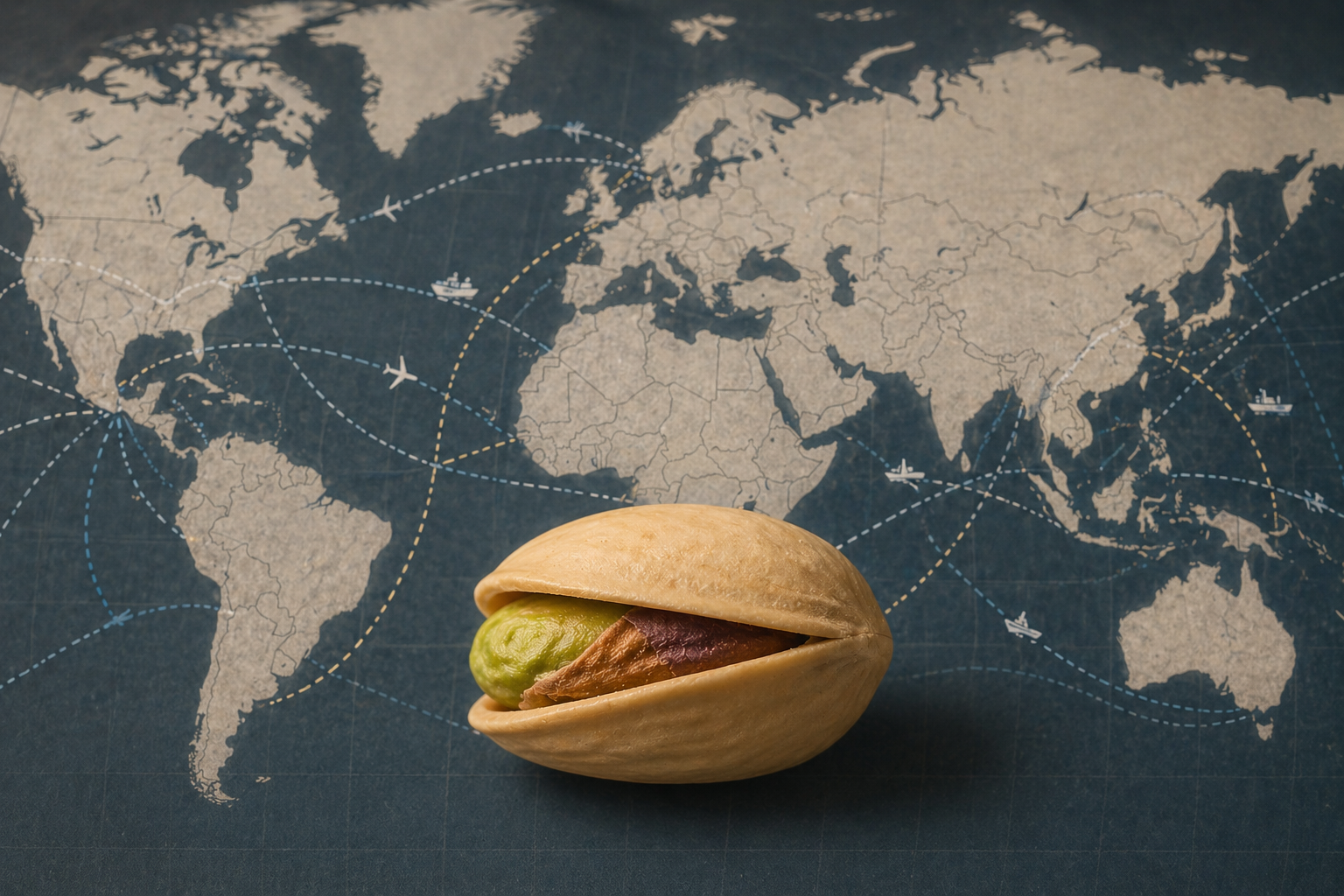
China remains a key pressure point. In 2024, it imported over 130,000 tons of pistachios, split primarily between the U.S. and Iran. That dual dependence means any disruption on the Iranian side immediately shifts demand toward American suppliers, tightening an already competitive channel. This is where the system starts to show strain. Pistachios are not fully interchangeable. Switching origin is possible, but not frictionless. Quality specifications, processing compatibility, and pricing tiers all come into play.
Pricing signals and volatility
Prices were already moving up before the current escalation. Over the past year, pistachio prices have increased by roughly 30% in some segments. In 2026, prices reached their highest levels in eight years, driven by both supply constraints and strong global demand.
The war has amplified that volatility.
“It’s like gambling – we don’t know at what price to sell. The war has made pricing highly unpredictable for pistachios.”— Behnam Heydaripour, quoted in Baking Business
This is not just a producer issue. For buyers, the uncertainty translates into shorter contract cycles, higher safety stock, and a willingness to pay premiums for immediate availability.
Compared to other nuts, pistachios behave more like a specialty commodity. Almonds, for example, benefit from a much broader production base in California and more standardized grading. Pistachios, by contrast, are more exposed to origin risk and harvest variability, including biennial bearing cycles. That makes price spikes sharper and substitution slower.
Logistics, payments, and the invisible constraints
The disruption is not only about how much product exists. It is about whether it can move.
Iranian exports depend on access to shipping routes in the Gulf, regional ports, and intermediary trading hubs such as the UAE and Turkey. When those routes become constrained - whether due to security risks, insurance costs, or operational slowdowns - the impact cascades quickly.
Payment flows add another layer. Sanctions, banking restrictions, and risk compliance checks complicate transactions even when physical supply is available. For smaller buyers, this can effectively remove Iranian origin from the sourcing mix.
That forces a rapid reconfiguration.
“The conflict is disrupting exports from Iran, one of the world’s largest producers, and tightening global supply. That is pushing prices higher in international markets.”— Ahmed Awais, quoted in S&P Global Market Intelligence. At the same time, alternative suppliers are not infinitely elastic. U.S. producers have strong output, but much of it is already committed through forward contracts. Turkey can absorb some demand, but its volumes are smaller and more variable. The result is a classic supply squeeze: available product exists, but not necessarily in the right form, place, or contractual structure.
Downstream impact: reformulation, substitution, and margin pressure
For food manufacturers, pistachios are rarely the largest cost input. But they are often a defining ingredient. That creates a different kind of decision problem.
Manufacturers are responding in several ways:
- Reformulating recipes to reduce pistachio content while maintaining product positioning
- Switching to alternative nuts such as almonds, hazelnuts, or cashews in lower-tier products
- Segmenting product lines, reserving pistachios for premium SKUs
- Renegotiating supply contracts with more flexible volume and pricing terms
Each option has trade-offs. Substitution affects taste and branding. Reformulation requires testing and regulatory checks. Premium segmentation risks volume loss.
Retail pricing is also starting to reflect the shift. In some markets, pistachio-based products are already seeing noticeable price increases compared to other nut-based goods.
This is where a relatively small commodity starts to matter. Pistachios sit inside higher-value categories - chocolate, desserts, snacks - where margins are sensitive and brand perception is tied to ingredient quality.
A disruption upstream becomes a strategic decision downstream.
A market stress test in real time
What makes the current situation notable is not just the disruption itself, but how quickly it propagates. A concentrated production base, dependence on specific trade routes, quality-driven demand, and financial friction points are all interacting at once. The system has limited redundancy.
For operations and procurement teams, pistachios are becoming a case study in managing specialty commodities under geopolitical stress:
- Diversification is necessary but constrained by product specifications
- Inventory buffers help, but only temporarily
- Supplier relationships and contract structures become critical leverage points
- Real-time visibility into origin, transit, and pricing is no longer optional
The broader lesson is not about pistachios alone. It is about how small, high-value inputs can expose structural weaknesses in global supply chains. When disruption hits a concentrated market, scale does not protect you. Structure does.