I Listened to 10 Earnings Calls and This Is What I Learned About the State of Our Sector
 By Freddie Bolton · May 9, 2026 · 4 min read
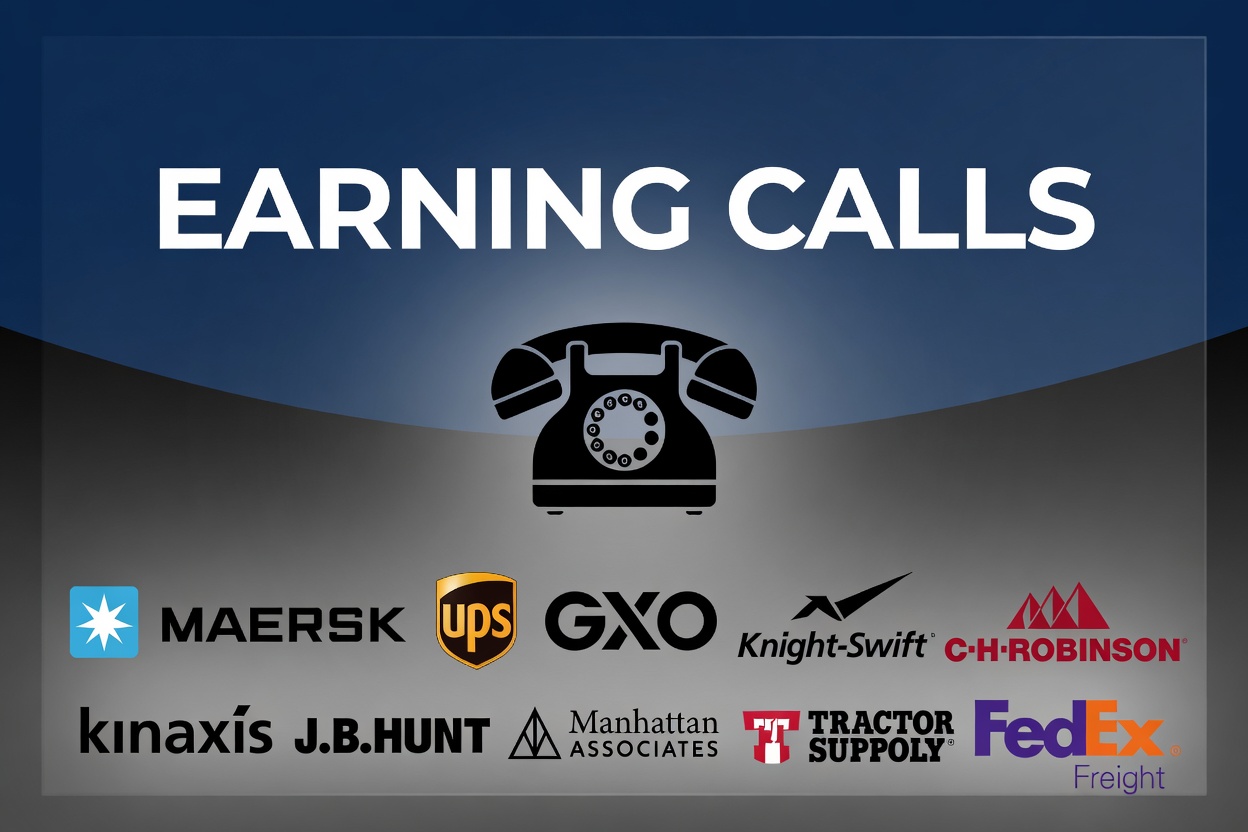
After listening to ten major Q1 2026 earnings calls across shipping, trucking, warehousing, retail, and supply chain software, one pattern became difficult to ignore: the industry is stabilizing operationally long before it is recovering financially.
Executives are no longer speaking like companies waiting for demand to suddenly return. Instead, they are talking about margin discipline, tighter execution, automation, contract quality, and resilience. The language itself has changed. Less optimism. More control.
That does not mean the industry is healthy. Freight markets remain volatile, overcapacity is still weighing on ocean shipping, trucking margins are fragile, and labor costs continue to pressure operators. But beneath that pressure, something more structural is happening: the strongest players are quietly reshaping how supply chains operate while weaker models are becoming harder to defend.
Maersk, one of the world’s three largest container shipping lines, handles the heavy lifting of global ocean freight. It solves for shippers the constant headache of volatile ocean rates and geopolitical disruptions such as the Hormuz situation.
CEO Vincent Clerc said: “We’ve seen strong demand across most regions this quarter, supporting robust volume growth in our three business segments.”
Revenue fell 2.6% to $13 billion, yet volumes rose 9.3% and EBIT reached $340 million.
What makes this striking is the anomaly: the industry is still dealing with massive supply overhang from new ships delivered in 2025-2026 and freight rates at rock bottom - yet Maersk posted strong volume growth anyway. It contradicts the usual narrative that overcapacity automatically kills demand. The more likely explanation is that underlying cargo demand remains resilient enough to absorb some of the excess capacity, at least for now.
UPS, the global package delivery giant focused on B2B and healthcare logistics, helps in-house supply chain managers secure reliable premium services when domestic volumes soften.
CEO Carol Tomé described the quarter as a “critical transition period.”
Revenue hit $21.2 billion with adjusted operating margin at 6.2%. International revenue grew 3.8% and healthcare contributed $3 billion. UPS is deliberately walking away from low-margin volume and winning with higher-value customers.
That strategy sounds disciplined, though it also reflects a market where profitable growth is becoming harder to find at scale.
GXO Logistics, one of the largest third-party logistics (3PL) providers, manages warehouses and end-to-end operations for clients who prefer not to own the infrastructure.
CEO Patrick Kelleher stated: “2026 is off to a strong start. In the first quarter, we delivered strong revenue growth and profitability.”
Revenue rose 11% to $3.3 billion, adjusted EBITDA jumped 23%, and organic growth stood at 4% across regions. Profitability improved despite fierce competition - proof that well-run 3PLs are extracting more value from the system.
Knight-Swift, one of the largest truckload carriers in the U.S., addresses the chronic issues of driver shortages and unstable domestic freight rates.
CEO Adam Miller noted the market is tightening due to regulatory enforcement.
Adjusted EPS was $0.09, but Q2 guidance improved sharply to $0.45-$0.49. After four difficult years, the domestic trucking cycle may finally be bottoming out.
Still, trucking executives have predicted recoveries before. The difference this quarter is that some of the tightening appears tied to actual capacity exits rather than temporary optimism.
C.H. Robinson, a major freight brokerage and logistics provider, connects shippers with carriers and finds capacity when the market shifts rapidly.
CEO Bob Biesterfeld said: “Our Lean AI strategy is a game-changer, providing us with a significant competitive advantage in supply chain management.”
Adjusted EPS rose 15% and NAST gross margins held at 14.6%, even as spot rates increased 19%. Volumes remained stable.
The anomaly here is unmistakable: spot rates normally pressure broker margins, yet C.H. Robinson protected profitability. Unlike many AI narratives currently flooding the logistics sector, the operational impact here appears measurable rather than theoretical.
Kinaxis provides AI-powered supply chain planning software. It helps in-house planners forecast demand accurately and avoid stockouts or excess inventory.
CEO Razat Gaurav commented: “We were thrilled with continued traction in scaling up our business through market leading innovations.”
Revenue grew 25% to $165.6 million, SaaS revenue 21%, and ARR 20%. Demand for planning tools remains robust, particularly among enterprises trying to reduce planning volatility rather than simply cut costs.
J.B. Hunt specializes in intermodal transportation - moving freight by rail and truck. It solves the challenge of controlling fuel costs and moving goods efficiently over long distances.
Revenue reached $3.06 billion (+5%), operating profit rose 16%, and EPS increased 27%. The results suggest intermodal efficiency continues gaining favor as shippers look for more predictable transportation economics.
Manhattan Associates supplies warehouse management systems (WMS) and automation software. It helps distribution center managers improve speed and accuracy in large fulfillment operations.
Revenue was $282 million (+7%), cloud revenue rose 24%, and remaining performance obligations grew 24% to $2.35 billion. Even in a cautious spending environment, companies are still prioritizing warehouse execution and cloud migration.
Tractor Supply, the leading rural lifestyle retailer, manages a complex supply chain serving remote locations.
Sales reached $3.59 billion (+3.6%), with 40 new stores opened and strong double-digit digital growth. The rural retail segment continues to perform more steadily than many analysts expected, despite broader consumer uncertainty.
FedEx Freight, the LTL division preparing for spin-off, provides regional and national less-than-truckload transportation.
Revenue and margins declined due to higher labor costs, but the planned June 2026 separation is expected to give the business more operational focus and financial flexibility.
Taken together, these calls point to an industry entering a different phase of the cycle. Not expansion. Not collapse. Consolidation.
The most consistent theme was not demand growth, but operational selectivity. Companies are becoming more disciplined about which freight they move, which customers they prioritize, where they automate, and where they protect margins. Technology spending is still holding up surprisingly well, particularly in planning, warehouse execution, and AI-assisted operations, even as broader macro conditions remain uneven.
That may ultimately be the clearest signal from this earnings season. Supply chain leaders are no longer operating under the assumption that a broad rebound will solve structural problems. They are redesigning networks, contracts, and operating models around the possibility that volatility itself is now permanent.
See you all in Q2.