Opinion: The physical world is AI's last and largest frontier
 By Jagdeep Singh, co-founder and CEO of Rhoda AI · Aug 11, 2026 · 4 min read
Walk a distribution center on a bad morning and you will find the same story in a dozen variations. A pick cell has stopped because a supplier sent parts loose in a carton instead of nested in a tray. A palletizer sits idle because the wrap on an inbound load caught the light in a way its vision system had never seen. Somewhere down the line a person is standing in for a machine that cost six figures, doing the one thing the machine could not do, which was notice that today is different from yesterday. None of that is exotic. That is Tuesday.
In roughly ten years, AI has rebuilt search, translation, image generation, and a good share of how software gets written. The part of the economy that moves physical goods has seen nothing close to that. The gap between those two worlds is the most interesting thing happening in industry right now, and it is worth being precise about why it exists.
Why Traditional Automation Is Reaching Its Limits
Automation in the physical world was built on a sound engineering assumption. The cheapest way to make a machine reliable is to remove uncertainty from its surroundings. So we did exactly that. Fixtures, jigs, fences, barcodes, controlled lighting, parts presented at a known angle in a known place. We reshaped the environment to suit the machine, and for high volume and low variety it worked better than almost anything else in industrial history. The tradeoff was that the intelligence lived in the setup rather than in the machine. Change the conditions and you are not adjusting a system, you are re-engineering one.
That tradeoff is now colliding with how supply chains actually run. SKU counts climb, order profiles fragment, suppliers change, labor availability moves month to month, and reshoring is pushing production into shorter and more varied runs. Variety has become the normal operating condition, and the automation paradigm most plants inherited treats variety as a fault.
Teaching Machines to Understand the Physical World
What has been missing is a scalable way to model how the physical world behaves. A machine can be trained to recognize a box. It has been much harder to give one the general expectations a person carries without thinking about them. What a box does when you tilt it. How a soft package settles differently from a rigid one. When a stack is about to shift. What happens to a part that arrives slightly out of position. People acquire that understanding before we can speak, mostly by watching. Encoding it rule by rule has never scaled, because the rules are effectively infinite.
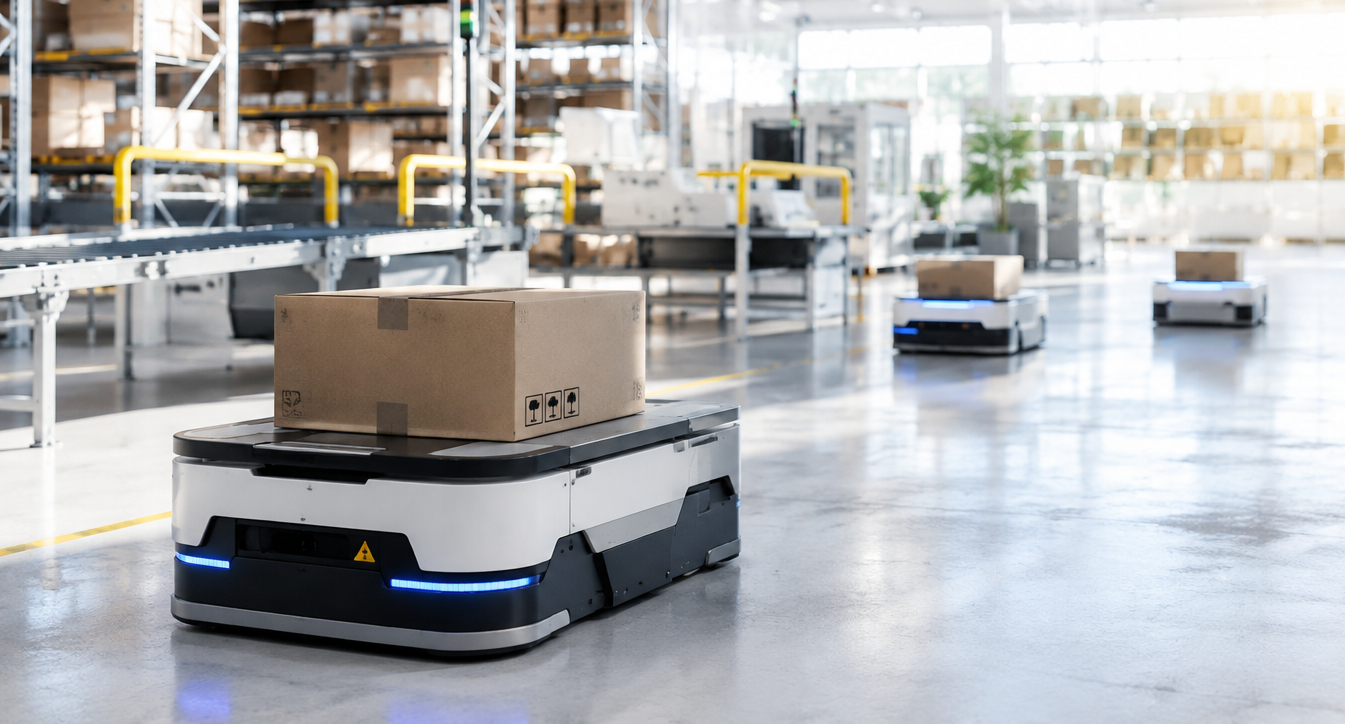
What makes this moment different is that learning that kind of physical understanding at scale has started to look tractable. I would not tell you it is solved, and anyone who tells you otherwise is selling something. What I will say is that the problem now looks reachable in a way it did not five years ago. That is my read of where the field is, not a settled fact, and reasonable people in this industry disagree with me about the timeline.
The Next Industrial Reorganization
If the direction holds, the closest historical parallel is electrification rather than the internet. When electric motors became available, most factories bought one, bolted it where the steam engine had been, and ran the same overhead shafts and belts off it. The gains were modest for years. The real productivity shift came later, once plant engineers worked out that a small motor could sit on every machine, which meant the floor could be arranged around the sequence of work instead of around a driveshaft. The technology arrived well before the reorganization it made possible, and the returns went to the companies willing to reorganize.
I expect physical AI to follow that shape. The first wave will be drop-in replacements, a more capable machine in the spot where a less capable one used to sit, with returns that look fine and change very little. The larger shift comes when operations are designed on the assumption that equipment can absorb variation. That changes what you demand from suppliers, how much you spend standardizing packaging, how you staff a shift, and how you decide what to keep in-house at all.
The Questions That Matter
For anyone evaluating this technology today, the demo is the least useful thing in the room. The question that matters is what happens when conditions change. Ask a vendor to run their system on your worst inbound load rather than their cleanest one. Ask what it does when it meets something outside its experience, because the difference between a machine that stops safely and a machine that fails badly is worth more than a few points of throughput. Ask how much of the performance depends on a person off camera. Ask how it behaves in week six, when the novelty is gone and the exceptions have piled up.
The digital decade rewarded speed. This one will reward operators who can tell the difference between a system that has memorized a task and one that understands the situation, and who start redesigning around the second kind before their competitors do.