Exporting Under Pressure: How Geopolitics Is Reshaping Israel’s Defense Supply Chain
 By Freddie Bolton · May 26, 2026 · 3 min read
For years, Israel’s defense industry operated under a relatively simple assumption: if demand existed, production capacity was available, and export licenses were approved, goods could move.
That assumption is beginning to break down.
The challenge facing Israeli exporters in 2026 is no longer limited to manufacturing or military demand. Increasingly, it is about logistics, routing, compliance, and political risk embedded deep inside the global supply chain itself.
Ports, carriers, insurers, customs authorities, and foreign regulators are all becoming variables in the export equation.
The issue came into sharp focus during a recent strategic conference hosted by Cargo Amerford under the title “Defense Transportation: Navigating Rough Seas.” The event gathered senior executives from Israel’s defense sector alongside officials from the Ministry of Defense to discuss the operational consequences of growing international restrictions and geopolitical friction.
Retired Brigadier General Aviram Sela, who leads Cargo Amerford’s defense sector activity, described the situation as a “cascade of international embargoes.” According to Sela, the impact is already visible across shipping and logistics operations, creating “dramatic increases in transportation costs and significant additions to maritime transit times.”
From Political Pressure to Operational Disruption
Global military spending reached a record $2.89 trillion in 2025, according to data presented during the conference, reflecting surging procurement activity worldwide.
At the same time, Israel faces mounting political and regulatory pressure across parts of Europe and the wider international system.
Several European governments have tightened export controls, reviewed defense-related cooperation, or imposed additional scrutiny on military-related trade involving Israel. Germany temporarily halted certain military exports in 2025 before later returning to case-by-case approvals, while Spain publicly pushed for stronger EU action regarding defense cooperation.
The operational impact is often indirect but highly significant.
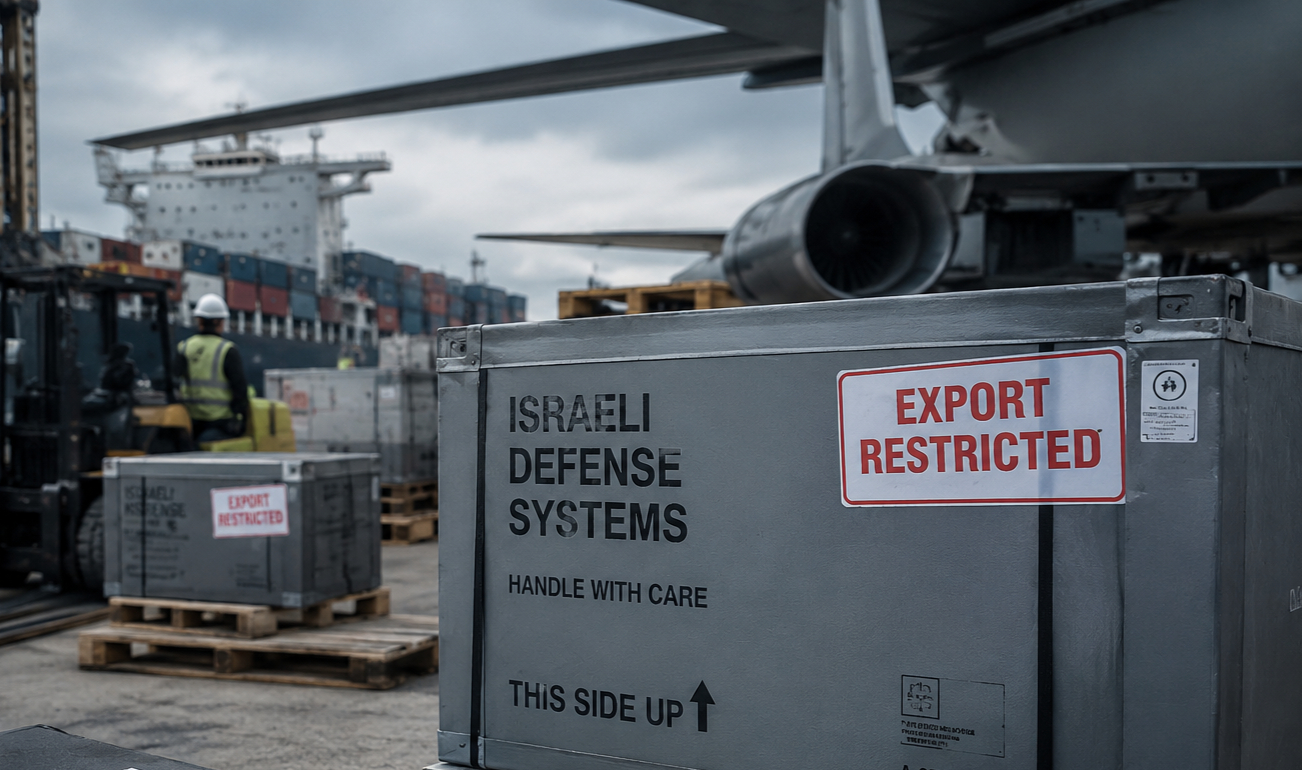
A shipment delayed in a European port. Additional compliance checks on dual-use components. Airlines unwilling to transport sensitive cargo. Insurance costs climbing sharply. Suppliers requesting additional legal guarantees before delivery.
Collectively, these frictions are reshaping how Israeli exporters think about supply chain resilience.
According to a Reuters-reported poll published in Germany in 2025, 73% of Germans supported tighter restrictions on arms exports to Israel, including 30% who supported a complete ban. Meanwhile, the British government suspended 30 out of 350 export licenses related to Israel during 2024 over concerns tied to international humanitarian law.
The Rise of Geopolitical Supply Chains
The traditional priorities of supply chain management - efficiency, cost reduction, and speed - are being replaced by strategic redundancy and geopolitical risk management.
Companies are increasingly forced to diversify transportation routes, expand emergency inventories, identify alternative suppliers, and reduce dependency on foreign infrastructure that could become politically vulnerable.
Israeli officials are openly acknowledging this transition. Shai Halperin, head of international defense transportation at Israel’s Ministry of Defense, emphasized the importance of decentralized logistics networks, expanded emergency warehousing, and stronger Israeli-controlled maritime and air transport capabilities.
“While others see limitations,” Halperin said, “international defense transportation creates solutions.”
The message reflects a broader shift in mindset across the defense sector: logistics is no longer merely operational support. It is becoming a strategic national capability.
Regulation Is Becoming Part of the Supply Chain
The government is also attempting to reduce friction internally.
Rachel Chen, Director General of Planning at Israel’s Ministry of Defense and former head of the Defense Export Controls Agency, described 2026 as an implementation year for reforms designed to accelerate licensing procedures and reduce bureaucracy.
The reforms include shorter registration timelines, expanded exemptions, and faster approval mechanisms for exporters.
But even these measures reveal the changing nature of global trade. As governments attempt to simplify procedures, more responsibility for compliance and risk management is shifting directly onto private companies.
In practice, this means supply chain executives are increasingly required to think like geopolitical analysts.
The broader trend extends far beyond Israel. Around the world, supply chains are becoming increasingly politicized as governments use export controls, sanctions, licensing restrictions, and trade leverage as strategic tools.
Defense logistics, once treated primarily as a technical discipline, is now deeply intertwined with diplomacy and international politics.
For Israeli exporters, manufacturing capability alone is no longer enough.
The new challenge is ensuring goods can still move through a global system that is becoming less neutral, less predictable, and far more political.