Hormuz: Supply Chains Absorb Shock as the Shift to Air Freight Loses Effectiveness
 By Evan Porter · Apr 19, 2026 · 3 min read
The Strait of Hormuz has shifted from acute disruption to a managed but unstable operating environment. Partial vessel movements have resumed under heightened military tension, but transit remains constrained, unpredictable, and insurance-sensitive. For global supply chains, the impact is now cascading beyond crude oil into air freight, refined fuels, and industrial inputs.
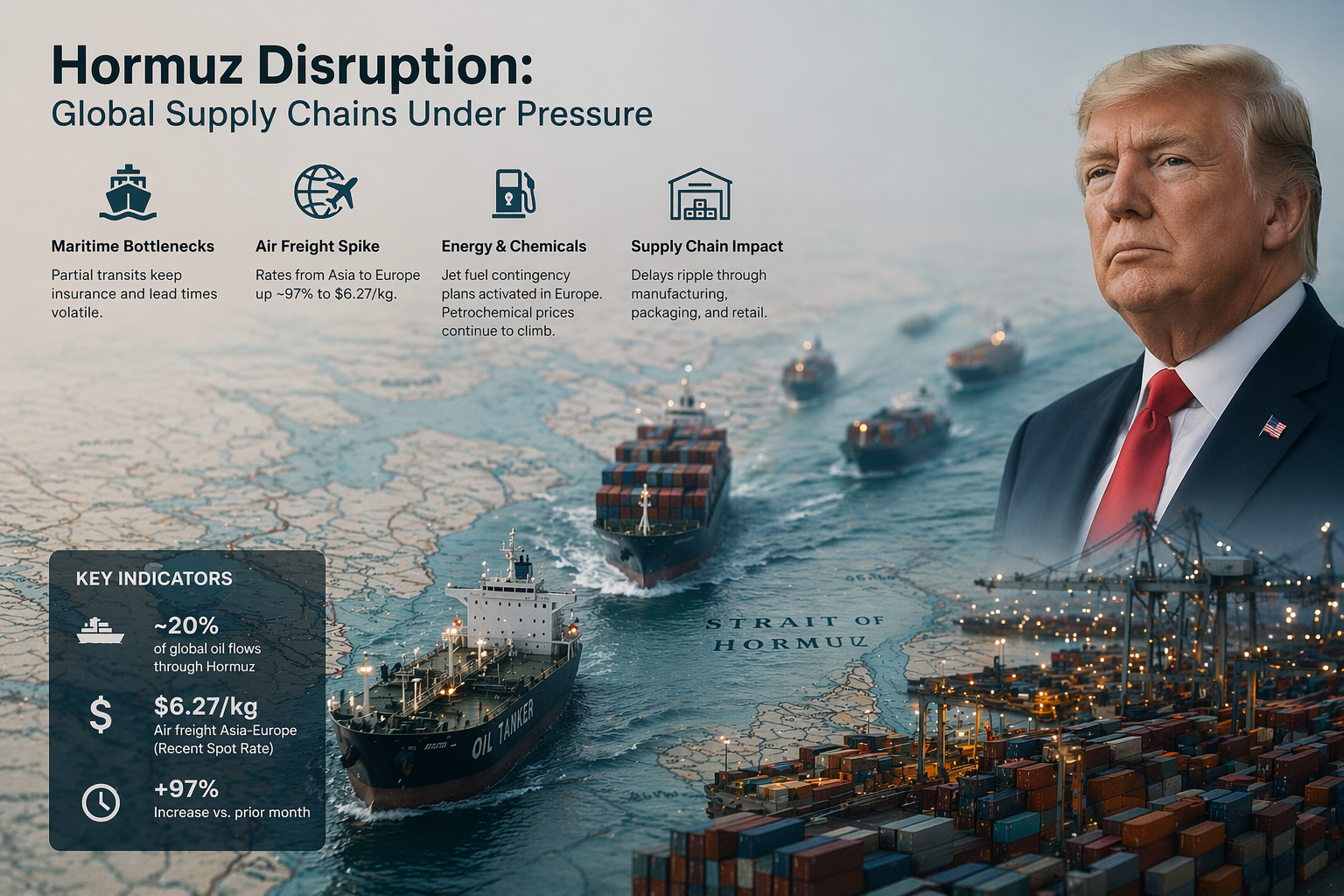
Roughly 20% of global oil and a significant share of LNG flows pass through Hormuz. Even partial disruption is enough to distort pricing, availability, and routing decisions across multiple tiers of supply chains.
From Oil Shock to Multi-Layer Supply Chain Stress
The immediate impact remains concentrated in energy markets, but second-order effects are now materializing. European jet fuel markets are already tightening, with contingency planning underway for potential stock releases. Record inflows from the U.S. and Nigeria indicate substitution behavior, not normalization.
Petrochemicals are the next pressure point. Middle East feedstocks such as naphtha are critical to polymer production. Recent market signals show sharp upward pressure on plastics and resins pricing, with downstream implications for packaging, automotive components, and consumer goods.
For supply chain operators, this marks the transition from commodity exposure to structural cost inflation across bill-of-materials.
Jukka Schulz of Hapag-Lloyd recently told The Supply Chainer that the company has “temporarily suspended selected services via the Strait of Hormuz” and is “offering alternative solutions via safer ports and inland connections - although these cannot fully replace regular routes and remain limited in capacity.” He added that services have been rerouted via the Cape of Good Hope and that a return to affected corridors will depend strictly on security conditions.
Air Freight Becomes the New Bottleneck
Air cargo is no longer a relief valve - it is now part of the disruption.
Capacity reductions of over 50% on key Middle East corridors have been observed, while spot rates from Southeast Asia to Europe have surged to approximately $6.27 per kg, nearly doubling within weeks. This indicates that companies are actively expediting inventory to compensate for maritime uncertainty, effectively bidding up limited air capacity.
The implication is clear: the traditional fallback strategy - shift to air - is losing viability at scale.
Rerouting Limits Expose Infrastructure Constraints
Alternative routing strategies are being deployed, particularly through ports outside the Strait such as Fujairah, Khor Fakkan, and Sohar. However, these nodes lack the throughput capacity of major Gulf hubs like Jebel Ali.
This creates a secondary bottleneck in port handling, transshipment, and inland logistics. The constraint is no longer just maritime passage, but end-to-end network capacity.
Supply chains dependent on Gulf imports or exports are now facing compounded delays - first at sea, then at port, and finally on land.
Diverging Risk Profiles: U.S. vs. Europe
For U.S.-based supply chains, the exposure is indirect but meaningful. Domestic energy production buffers immediate supply risk, but cost inflation in petrochemicals, plastics, and transportation will feed into manufacturing and retail margins. There is also a potential competitive upside for U.S. producers leveraging domestic feedstocks.
Europe faces a more immediate operational challenge. Higher dependency on imported energy and refined products from the Middle East increases vulnerability to both price spikes and physical shortages. Jet fuel, LNG, and chemical inputs are the most exposed categories.
For European supply chain leaders, this is no longer a pricing issue - it is a continuity risk requiring active mitigation.
What Supply Chain Leaders Should Prioritize Now
Energy-intensive manufacturers, chemical-dependent industries, and organizations with exposure to Middle East trade lanes should already be in response mode.
Key actions include:
- Securing alternative suppliers for critical inputs such as resins and fuels
- Building targeted buffer inventory rather than broad stockpiling
- Re-evaluating air freight usage and cost thresholds
- Monitoring port capacity constraints in Gulf-adjacent routes
- Stress-testing network assumptions under prolonged partial disruption
The current phase suggests that even if transit improves, volatility will persist. The operational baseline has shifted from efficiency to resilience under uncertainty.
A verified recent quote from Donald Trump related specifically to these developments is unknown.