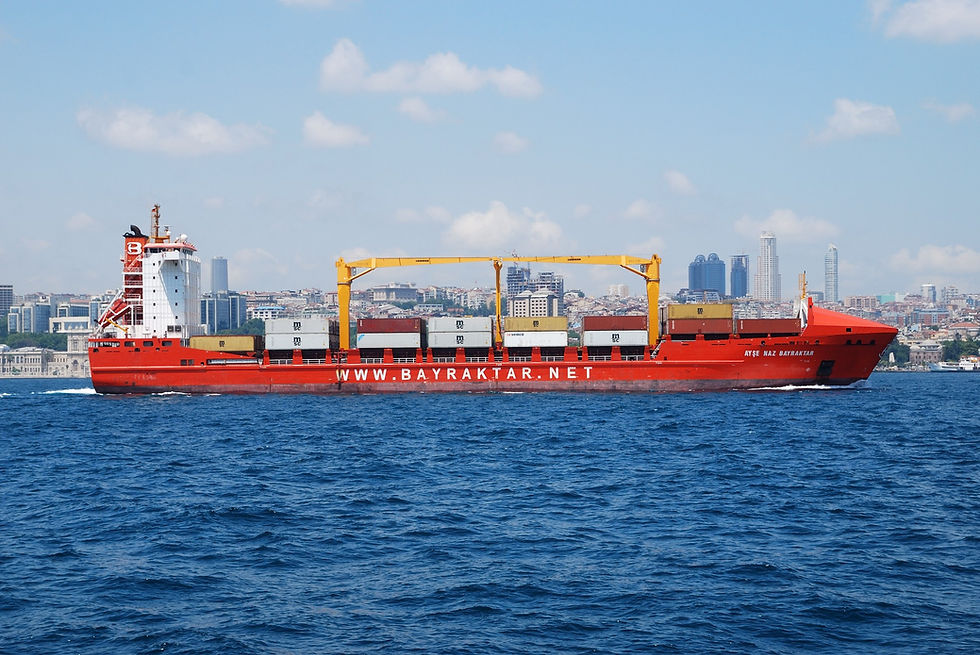
A Vessel Loss Can Stop Production Long Before Replacement Cargo Arrives

When a commercial vessel is lost, confirming the affected cargo is only the beginning of the supply-chain response. The immediate operational question is what that inventory was supposed to support: a production schedule, a customer delivery or replenishment at a location with little remaining stock. Replacing the shipment may require a different route, another supplier or selective acceleration of the most consequential goods. Those choices depend on reliable shipment information and authority to act before available inventory runs out.
Written responses from UST and Magaya address complementary parts of that problem. UST focuses on concentration risk and the threshold for changing supply arrangements. Magaya examines how teams identify affected shipments and coordinate the response.
Identify The Order Behind The Vessel
Matt Fotouhi, Chief Product and Innovation Officer, Magaya Corporation, argues that tracking positions alone does not establish operational control. “A map full of moving dots can create the illusion of control,” he said in comments provided to The Supply Chainer. “When a vessel is attacked, the real test is whether a team can quickly identify which shipments are affected, understand the consequences, and coordinate a response.”
Fotouhi recommends confirming which shipments are involved and establishing the latest reliable status after a vessel is lost. Customers and partners should be notified, the insurer contacted, and the implications for inventory, delivery commitments and operations assessed. He also emphasizes clear updates while details remain uncertain. That distinction matters because a team can communicate what has been confirmed without presenting an unverified cargo status as a settled outcome.
The operational handoff is between shipment identification and business impact. A container reference needs to connect to the products it contains, their intended destination and the commitments depending on them. Without that connection, transport teams may know which vessel is involved while production and customer-service teams remain unable to assess their exposure. The responses describe a recommended approach, rather than a documented recovery from a named incident.

Compare Replacement Time With Inventory Cover
Eric Pilkington, Group Chief Executive and General Manager, UST Evolve, places the exposure within a broader concentration-risk assessment. He recommends mapping critical products to their routes, ports and suppliers, then qualifying alternatives before circumstances force a decision. Inventory buffers and alternative capacity should be concentrated where a lost shipment would halt production or jeopardize an important customer commitment. His approach does not call for increasing inventory indiscriminately.
“Production stoppages, missed deliveries, and emergency replenishment costs can far exceed the cargo’s actual invoice value,” Pilkington said. He also warns that widespread rerouting can constrain capacity through longer voyages, extending disruption to businesses without goods on the affected vessel. That is a mechanism for wider exposure, rather than a quantified estimate of losses from a particular attack.
Pilkington identifies a decision threshold: act when a credible disruption threatens to extend replenishment beyond available inventory cover. The comparison needs a realistic replacement timeline, including any work required to qualify another source. An alternative that exists commercially may still be unavailable operationally when the stock is needed. Where rerouting cannot restore supply within the business’s tolerance for interruption, he recommends qualifying alternative suppliers.
Check Whether The Alternative Removes The Dependency
Earlier coverage by The Supply Chainer examined why another supplier may leave transport exposure unchanged. Nari Viswanathan, Head of Product Marketing and Solutions for Supply Chain and Direct Spend, Coupa, said: “If the primary and backup suppliers both depend on the canal, a second contract offers little protection from a transit delay.” His comments concerned transport-dependent sourcing, rather than a vessel-loss response. They identify a relevant test for any replacement plan: whether it provides a usable path around the disrupted dependency.
Pilkington recommends establishing safety and legal constraints first, then comparing costs within those boundaries. The premium for another route or supplier should be weighed against the consequences of a stockout, with acceleration reserved for goods whose economics justify it. That makes prioritization a product-level decision rather than an automatic instruction to expedite every affected order. Some inventory may be replaceable within existing cover, while other items require immediate intervention.
Authorize The Response Before The Alert Arrives
Fotouhi advocates exception-based visibility to direct attention toward shipments requiring action and distribute information to customers, carriers, agents, customs brokers and drayage partners. Pilkington adds that AI should connect risk signals with inventory and commitments, rather than produce a supposedly precise probability of attack. Both perspectives make the decision process central to the value of the information. Neither response provides measured recovery-time improvements or a quantified customer outcome.
“Also, companies should agree thresholds and decision-making authority in advance because faster alerts are useless if no one is authorized to respond,” Pilkington said. That authority needs to cover the trade-offs exposed by a replacement plan, including additional spending and changed customer allocations. After an incident, Fotouhi recommends reviewing how alerts, decisions and communications performed. The useful result is a response process that can identify which commitment is at risk, select a feasible alternative and authorize it while inventory still provides time to act.