4 Shipping Companies Present a Greener Course. Emissions Are Still Moving in the Other Direction
 By Evan Porter · Sep 21, 2026 · 6 min read
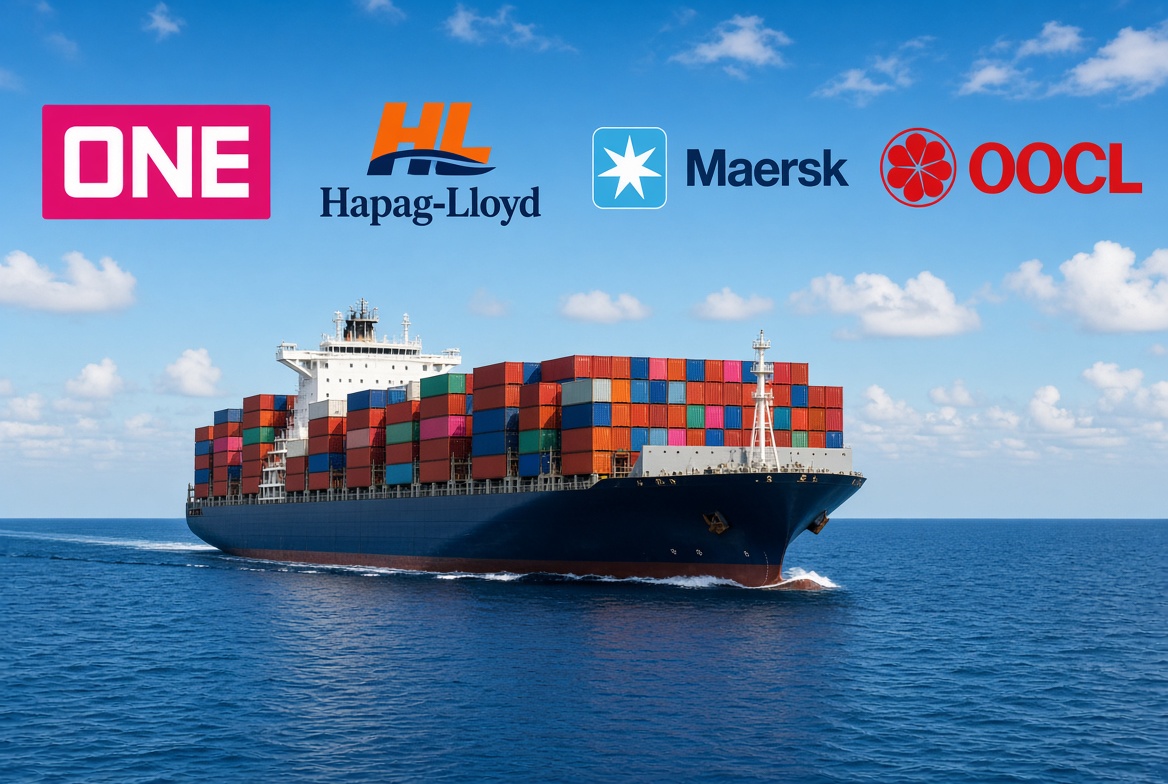
The latest sustainability reports from ONE, Hapag-Lloyd, Maersk and OOCL point to meaningful investments in more efficient vessels, alternative fuels, route planning and technologies that reduce fuel consumption. Yet the data also reveal the limits of that progress: absolute emissions have increased at some companies, most energy still comes from fossil fuels, and vessels described as “future-ready” may continue operating on conventional fuel for years.
Shipping cannot become clean through better ESG language alone. The industry operates enormous engines, burns millions of tonnes of fuel, emits carbon, nitrogen oxides, sulphur oxides and particulate matter, and creates persistent risks involving wastewater, ballast water, lost cargo and marine spills.
At the same time, shipping carries most global trade and is more efficient than many alternatives when measured by cargo volume and distance. The real question is not whether shipping pollutes, but whether current investments are changing its underlying structure quickly enough, or merely improving the ratio between pollution and output.
ONE: Better Efficiency, Higher Emissions
Ocean Network Express’ Sustainability Report 2026 covers the period from April 2025 through March 2026. ONE reports a 65% reduction in Scope 1 emissions intensity from its 2008 baseline, putting it on course toward its 70% reduction target for 2030.
During the year, the company received 14 S-Series vessels designed for greater efficiency and future compatibility with methanol and ammonia. Biofuel use increased substantially, while the company also highlighted AI-powered routing, propeller and hull modifications, and the use of shore power.
ONE itself provides an important qualification: “A reduction in intensity does not equate to a reduction in absolute emissions.” Elsewhere, it states: “Fuel consumption is a primary contributor to our emissions footprint.” These statements place the headline achievement in the correct context: vessels are becoming more efficient for each unit of cargo, but that does not mean the company as a whole is emitting less.
In fact, ONE’s Scope 1 emissions increased from 11.71 million tonnes of CO₂e in the previous financial year to 12.19 million tonnes. The company attributes this to longer routes around the Cape of Good Hope and an increase in the number of operating vessels from 276 to 312.
This is not a regulatory breach or operational failure, but it is a clear weakness. The report’s most prominent environmental achievement is a reduction in emissions intensity, while the company’s absolute climate impact increased. The report also records zero significant spills, defining a significant spill as more than 150 litres overboard per incident. This indicates sound operational discipline, but the definition excludes smaller spills, and the report does not provide a cumulative figure showing whether such incidents are genuinely negligible.
Hapag-Lloyd: An Ambitious Target Against Rising Fleet Emissions
Hapag-Lloyd aims to reduce its fleet’s absolute emissions by approximately one-third by 2030, reaching 10 million tonnes of CO₂e compared with its 2022 baseline. Its relative target is a 53% reduction in emissions intensity, while the company plans to achieve net-zero fleet operations by 2045. The progress report details greater use of biofuels, a biomethane supply agreement with Shell, fleet renewal, propeller and hull upgrades, and orders for vessels with dual-fuel propulsion.
The company states: “We remain firmly committed to our targets.” Elsewhere, it acknowledges that “a challenging operating environment shaped our absolute emissions.” This is comparatively candid reporting because the company does not rely exclusively on efficiency metrics or conceal the direction of absolute emissions. The uncomfortable figure is that fleet emissions reached 18.6 million tonnes of CO₂e in 2025, compared with 15.6 million tonnes in the 2022 base year. The company is therefore seeking to reach 10 million tonnes within five years after emissions increased by approximately three million tonnes during the first three years of the period.
Hapag-Lloyd attributes the increase to Red Sea diversions, the launch of the Gemini network and a 13% increase in transport performance. At the same time, it reports a 19% improvement in emissions intensity compared with 2022. The operational explanation does not eliminate the contradiction. If the target concerns absolute emissions, business growth and longer routes are not footnotes. They are part of the problem the strategy must address. The report gains credibility by disclosing the increase, but the gap between the current 18.6 million tonnes and the 10 million-tonne target makes the second half of the decade considerably more challenging than the report’s more optimistic passages suggest.
Maersk: A Methanol Pioneer, but the Transition Remains Small Compared with the Fleet
Maersk incorporates its sustainability reporting into its 2025 annual report. The company maintains its target of reaching net-zero emissions by 2040, with interim goals to reduce Scope 1 emissions by 34.7% and Scope 3 emissions by 21.9% by 2030 from a 2022 baseline.
During 2025, Maersk added ten methanol-capable dual-fuel vessels, carried out 640 fuel-saving initiatives across 380 vessels and achieved a record Energy Efficiency Operational Indicator of 10.8 grams of CO₂ per tonne-nautical mile. Maersk describes the central requirement clearly: “Growth must be decoupled from negative impacts.” It also acknowledges that “our energy transition is an ongoing learning exercise.” The second statement is especially important because the pathway is not settled. The availability, price and production source of each fuel will determine whether a dual-fuel vessel is genuinely a lower-emission solution or merely another vessel burning fossil fuel.
Maersk made green methanol a symbol of shipping’s energy transition. It subsequently broadened its fuel strategy and ordered vessels capable of operating on LNG. This does not cancel its investment in methanol, but it sits uneasily alongside Maersk’s own warning that LNG could divert investment away from genuinely low-emission fuels and lock in carbon and methane emissions.
Ten new methanol-capable vessels also represent a small proportion of a fleet numbering in the hundreds, and not all methanol is green. When verified e-methanol or biomethanol is unavailable, a dual-fuel engine can continue operating on conventional fuel.
Maersk should therefore be judged by the share of low-emission energy actually consumed, rather than by the number of vessels theoretically capable of using it.
OOCL: Improving Data, but LNG Receives Too Green a Label
OOIL’s Sustainability Report 2025, covering OOCL and the wider group, sets a net-zero target for 2050. The company reports a 58.1% reduction in emissions intensity compared with 2008, exceeding its interim target. It also aims to reduce absolute annual emissions by at least 20% by 2030 and at least 70% by 2040.
OOCL ordered 14 methanol dual-fuel vessels with a capacity of 18,500 TEU, in addition to seven larger methanol-capable vessels ordered previously.
OOIL states: “GHG emissions are one of the most material climate-related issues.” It also says: “We aim to minimise our discharges, wastes and other pollutants.” The report includes limited external assurance and provides relatively detailed information on emissions, waste, water and fuel consumption. In 2025, marine biofuels represented 8.06% of the company’s marine fuel consumption, while heavy fuel oil alone accounted for 30.37% of total energy consumed. Emissions intensity fell to 32.5 grams of CO₂e per TEU-kilometre, but the figures also demonstrate that alternative fuels remain secondary within an energy mix still dominated by fossil sources.
After publishing the report, OOCL ordered another 12 vessels with dual-fuel LNG engines and presented them as part of building a “greener fleet.” That description is overly generous. LNG can reduce local air pollutants and produces less CO₂ during combustion, but methane leakage throughout the supply chain and methane slip from engines can erode much of its climate advantage.
An LNG-capable vessel is not a zero-emission vessel.
Better Reports Do Not Necessarily Mean a Clean Industry
The four reports demonstrate genuine change. The companies are investing in modern fleets, alternative fuels, monitoring, route planning and lower energy consumption. Publishing Scope 1, Scope 2 and selected Scope 3 data, combined in some cases with external assurance, also enables scrutiny that would not previously have been possible.
However, a consistent gap remains between the language of the reports and the environmental outcome. Terms such as “dual-fuel,” “future-ready,” “green fleet” and “net-zero pathway” describe capabilities or intentions, not necessarily present-day performance.
A vessel capable of using methanol or ammonia may still burn fuel oil. An LNG vessel still uses fossil fuel. Emissions intensity may decline while total emissions rise.
The most meaningful measurements over the coming years will not be the number of pilot projects or vessels prepared for alternative fuels. They will be the quantity of fossil fuel actually burned, absolute lifecycle emissions, the verified share of renewable energy, and the scale of pollution released into the air and sea. By those measures, all four companies are moving, but none is yet close to transforming shipping from a polluting industry into a clean one.