Resilient Supply Chain Podcast: Why Visibility Fails Without Execution
 By The Supply Chainer · Jul 16, 2026 · 4 min read
The latest roundtable edition of the Resilient Supply Chain Podcast, hosted by Tom Raftery, examines why better visibility does not automatically produce better operational performance.
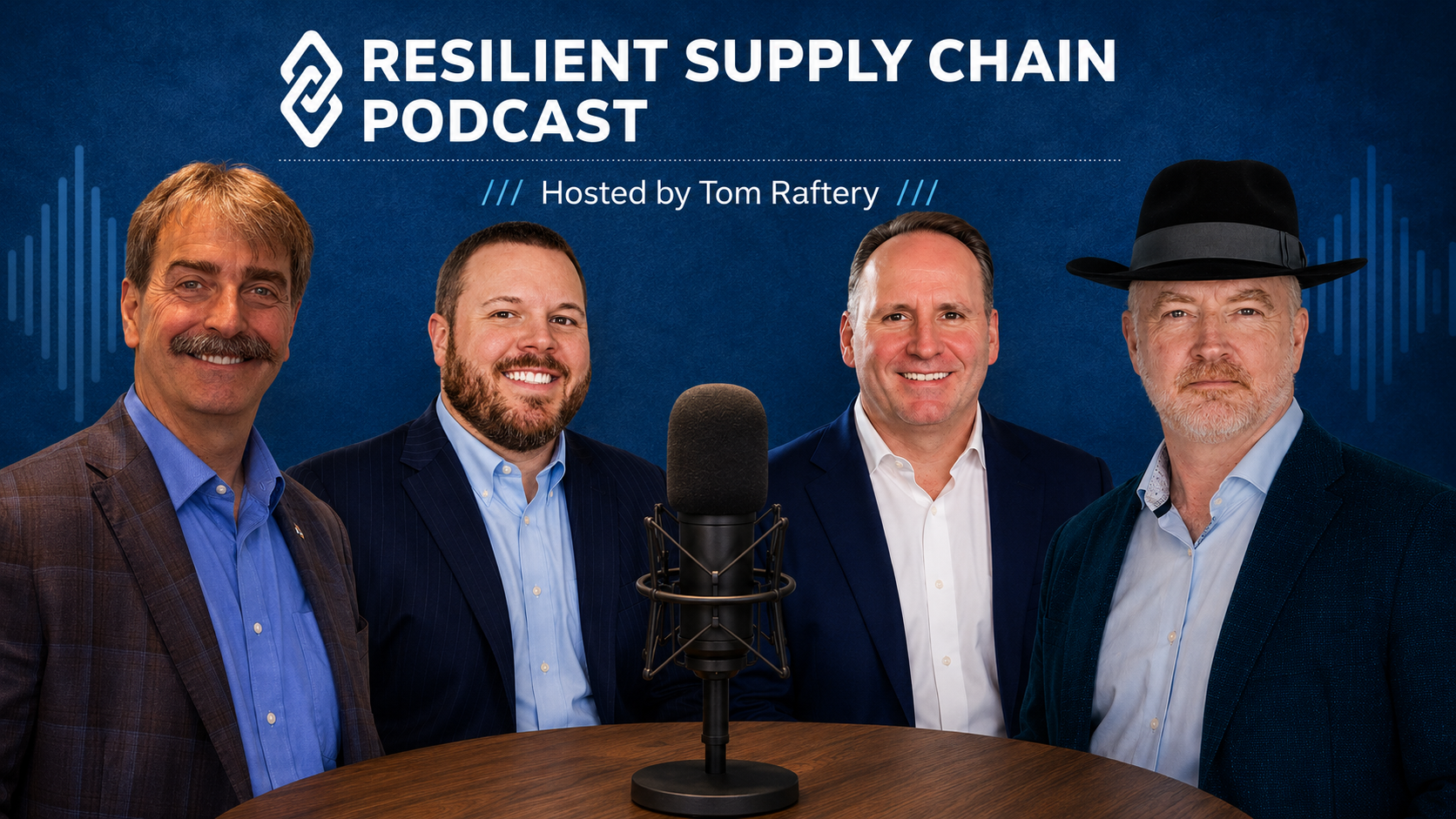
Raftery is joined by Matt Yearling, CEO of YMX Logistics; Chad Fox, Manager and Delivery Lead at Miebach Consulting; and Kurt Neutgens, CEO and co-founder of Orange EV.
The discussion focuses on the gap between seeing what is happening across warehouse, yard and transport operations, and having the processes, ownership and equipment reliability required to act. For supply chain leaders facing cost pressure, labour constraints, decarbonisation targets and increasingly complex technology choices, that distinction is becoming critical. The full episode is available at www.resilientsupplychainpodcast.com
Visibility Without Ownership
The central tension is that many organisations now possess more operational data than ever, yet remain slow to convert it into action. Warehouse management systems may know what is inside the building. Yard management systems may know where trailers are located. Transportation systems may understand shipment status. The failure often appears between those systems.
Fox identifies the handoffs between inventory, warehouse, yard and transportation as the points where responsibility becomes blurred. He argues that operational problems frequently emerge not because information is unavailable, but because ownership is unclear once information moves between systems.
“WMS may know what’s in the warehouse. YMS knows what trailers are in the yard. TMS knows what’s happening on the transportation side. But without clear visibility into how that information relates, and without clear ownership of what happens next, organisations struggle to decide what should be prioritised and who is responsible for acting,” Fox said.
Visibility alone does not determine which trailer should move next, which order should be prioritised or who has authority to escalate a problem.
As Fox notes, the real issue is often “a lack of ownership and clear escalation paths”.
That turns a data problem into a governance problem, with time, labour and throughput lost while teams wait for a decision.
The Yard as an Unrecognised Constraint
The yard frequently receives limited strategic attention because it represents a relatively small share of overall transportation spend.
Its operational influence, however, extends well beyond its direct cost. Yearling argues that companies often misunderstand how their yards are actually being used. In many facilities, the yard serves as more than a parking area. It may function as overflow warehouse space, support just-in-time manufacturing operations or act as a buffer that protects outbound shipping performance.
“What appears on paper and what is actually happening operationally are often two different things. Companies are using yards in ways they do not fully recognise. In some cases it is an extension of the warehouse. In others it supports manufacturing operations or outbound velocity. If leaders do not understand how the site is really operating, they risk optimising formal systems while missing the factors that are actually driving performance,” Yearling said.
That creates risk when leaders optimise formal systems without examining real site behaviour.
“But you can’t automate, you can’t optimise without understanding how you’re executing today,” Yearling says.
The implication is that process discovery must come before technology deployment.
Otherwise, companies risk applying automation to informal workarounds rather than correcting the underlying operating model.
Standardisation Before Scale
Multi-site programmes create another governance challenge. Local flexibility is necessary, but unchecked customisation produces site-by-site exceptions that make systems harder to maintain and networks harder to manage.
Fox argues that process should be standardised before data structures, system configuration or automation are scaled.
“Regardless of network size, the priority needs to be aligning on processes first and making sure governance is in place before moving on to systems and technology. If organisations scale before agreeing on how work should be performed, they simply create site-by-site exceptions that move them further away from a repeatable operating model,” Fox said.
A common operating model provides the baseline from which legitimate exceptions can be assessed rather than simply accumulated.
This is particularly important for large organisations, where pressure to accelerate implementation can reduce the time devoted to process design, testing and ownership.
A technical go-live may still fail to deliver the intended business outcome if the operating model remains inconsistent.
Reliability Before Autonomy
The conversation also challenges the assumption that an autonomous asset creates an autonomous operation. An autonomous yard truck can perform specific repetitive moves, but it cannot coordinate every task, exception and priority across the yard. Yearling argues that the industry often overstates what autonomy can currently deliver because many yard activities still require broader operational coordination.
Reliability may therefore matter more than technological novelty. Neutgens cites a shift from roughly 80% diesel uptime to 97-98% electric uptime, alongside the removal of operational fuelling downtime.
“When uptime increases from around 80 percent to 97 or 98 percent, the operational impact is significant. Organisations spend less time dealing with interruptions, swapping equipment or responding to breakdowns. We have also eliminated operational fuelling downtime. In many environments that can represent substantial time savings across a fleet. Reliability creates a foundation that allows teams to focus on execution rather than constantly reacting to equipment issues,” Neutgens said.
That changes labour requirements, backup asset needs and interruption risk before full autonomy is considered. The broader lesson is that supply chain resilience depends on the quality of the decision layer connecting systems, people and physical assets.
Leaders may continue investing in visibility, AI and automation, but value will depend on clear accountability, dependable data and operating processes capable of turning insight into action.