
Opinion: The Vendor Onboarding Check That Prevents MSE Payment Risk
 By Ravinder Kapoor, Founder of Procurement Wala · Sep 25, 2026 · 3 min read
Most companies, whatever the industry, have a vendor onboarding process. A new supplier gets added, bank details are taken, a purchase order goes out, and the relationship starts. One question is often skipped along the way. Is this vendor a Micro or Small Enterprise.
The 45-day rule most companies never isolate
The risk here is specific, and there is no room to negotiate it later. Under Section 15 of the MSMED Act, if a company buys from a Micro or Small Enterprise and does not pay within 45 days, interest starts adding up on its own, at a rate much higher than any bank loan, regardless of why the payment was delayed. This protection applies only to Micro and Small Enterprises. Medium enterprises are registered under the same MSME framework, but they are not covered by this particular rule, so treating all MSME vendors the same hides where the real exposure actually sits.
Delayed payments are rarely deliberate. They usually happen because of cash flow timing, an invoice dispute, approval delays, or simply not knowing which vendors this rule applies to. That last reason is the one procurement can actually fix, and it is also the one most companies never track until someone from outside comes looking.
How the exposure surfaces in audit
I have seen this happening during a year end statutory audit. None of the vendors involved had raised a complaint or asked for interest. The auditors pulled the vendor list themselves, checked MSE registration against payment dates, and found a set of vendors paid well beyond 45 days. They then asked accounts payable to calculate compound interest on every one of those delayed payments, pay it, and submit evidence that it had been paid. If not, this would be written into the audit report for management to see. Nobody in finance had been tracking this. The company only found out because someone finally checked.
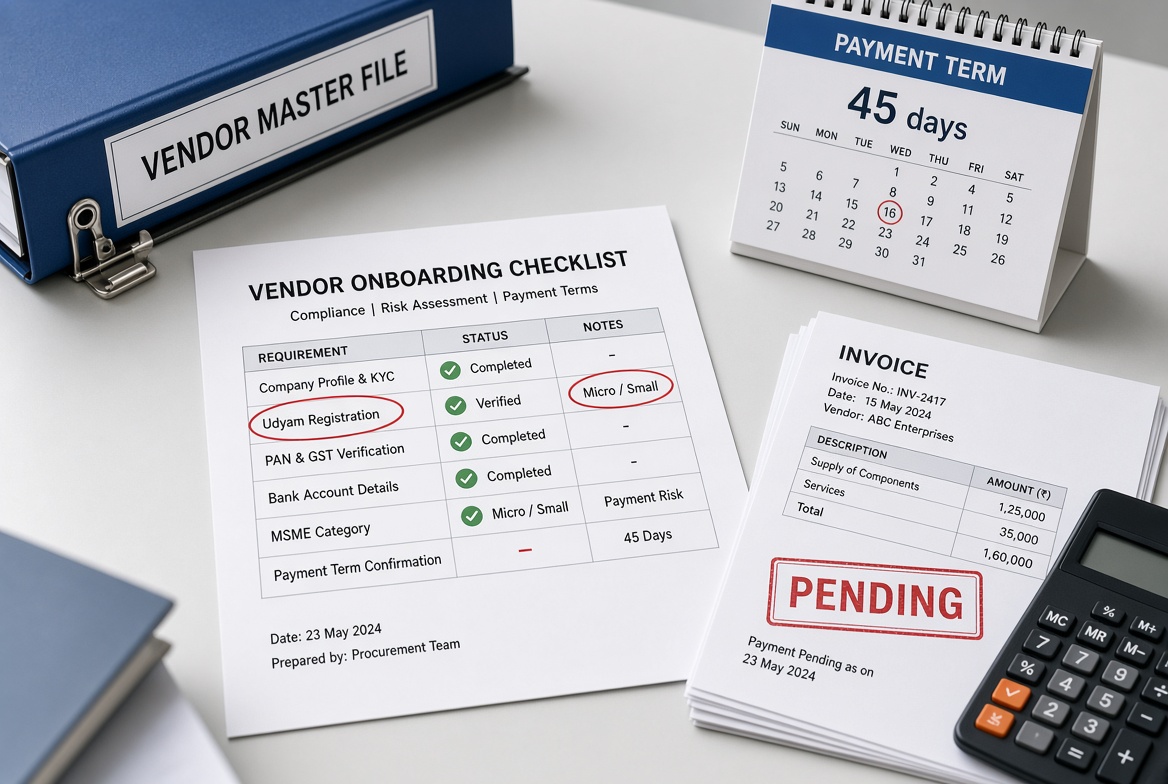
Most vendor master data is built around GST number, PAN, and bank account. Udyam registration, the actual proof of MSME status, is often missing or never checked at onboarding. Even when it is captured, the category, Micro, Small, or Medium, is frequently ignored, even though that category is what decides whether the 45 day rule applies at all.
Three checks that close the gap
Three small changes can fix most of this:
- Make Udyam registration and category, Micro, Small, or Medium, mandatory fields at vendor creation. This is what tells you which vendors carry real legal risk if paid late.
- Tag Micro and Small vendors separately in whatever system is already in use, so accounts payable can filter and see which invoices are close to the 45 day deadline. No new software needed.
- Review outstanding payments to Micro and Small vendors once a month against that deadline. A simple spreadsheet check by the accounts payable lead usually catches the problem before an auditor, or a vendor, catches it first.
The cost of doing this is small, one more onboarding question and twenty minutes a month.
Why a small onboarding field is worth the attention
Compare that small effort to what happens if this is ignored, interest that builds up automatically, an audit finding that lands directly on management's desk, and payments that pile up once a vendor disputes something. Skipping this small step is simply not worth the risk.
The cost is not only financial. Once a Micro or Small vendor escalates to the Micro and Small Enterprises Facilitation Council, or an auditor puts it in writing, the relationship and the reputation rarely recover quietly. Good vendors are increasingly choosing who they work with, and payment discipline is part of that decision.
This is not a compliance overhaul. It is one more field that deserves the same attention procurement already gives GST validation or bank account verification, both already mandatory in most onboarding checklists. In 37 years across manufacturing, infrastructure, and technology procurement, the costliest problems I have seen were rarely the complicated ones. They were usually the small, boring checks nobody made mandatory. This is one of them, and it is completely preventable with a simple checklist change, not a system overhaul.
Ravinder Kapoor is the Founder of Procurement Wala, a procurement consulting and Virtual CPO practice.