Freight Forwarders Split on AI as Expertise Gap Widens
A missed rate quote. A delayed customs clearance. A shipment rerouted without client notification. These operational failures increasingly trace back to a common source: freight forwarders lack the internal expertise to deploy AI tools that could prevent them. Nearly half cite skills deficits as their primary barrier to adoption, yet the gap between large and small operators continues to widen as automation becomes table stakes for competitive service delivery.
The modernization divide is sharpening. According to Magaya's 2026 Freight Forwarding at a Crossroads report, 20 percent of small forwarders have no major technology plans compared to just six percent of larger firms. The gap isn't purely financial. It reflects structural constraints around integration complexity, change management capacity, and the operational bandwidth required to retrain teams while maintaining daily client service.
The Skills Barrier Is About Time, Not Willingness
According to Mark Buman, Chief Revenue Officer at Magaya, a cloud-based logistics software provider, the barrier is time, not willingness. "The upskilling challenge in this industry isn't really about willingness. It's about time. Freight forwarding and customs brokerage are moving trains. Cargo has to keep flowing, and pulling people off the floor to learn a new skill set is a real operational cost, not just a training line item. That's especially true on the customs brokerage side, where the stakes of a wrong decision are high and there's less appetite for experimentation," Buman said in written responses to The Supply Chainer. "There's also a healthy skepticism at play. CBP has been clear that the licensed customs broker has to remain the final decision-maker, even when AI is assisting."
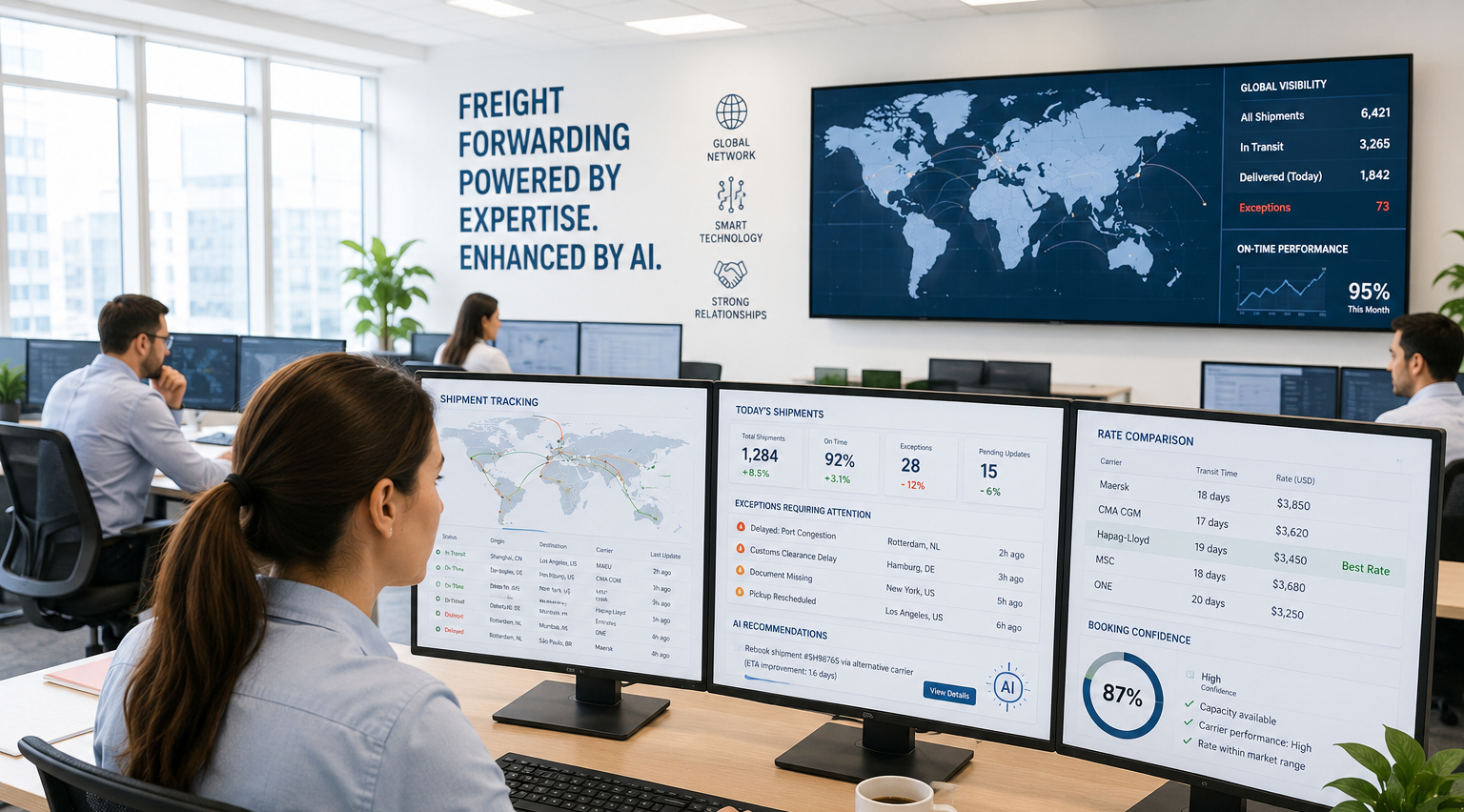
That tension between automation and relationship preservation defines the current adoption environment. Ninety percent of forwarders surveyed by Magaya cite trusted relationships as their top success driver, yet operational efficiency increasingly depends on AI-driven rate optimization, shipment tracking, and exception management. The forwarders managing that balance successfully are investing heavily in parallel training programs that teach teams not just how to use AI tools, but when to override them.
Small Operators Face Structural Lock-Out, Not Just Budget Constraints
The 20-versus-6 percent gap between small and large forwarders on modernization plans suggests more than reluctance. Smaller operators face compounding barriers: software costs that don't scale down proportionally, integration requirements that exceed their IT capacity, and change management demands that conflict with thin staffing.
Nitin Jayakrishnan, CEO and co-founder of Freehand, a logistics orchestration platform, previously told The Supply Chainer that execution speed separates manual and automated freight operations. "Most companies don't lose when a corridor goes down, they lose in the 72 hours after while someone manually tries to rebalance carriers, modes, and costs without a system that can see all options at once. AI platforms that integrate carrier performance data, rate benchmarks, and real-time capacity can automate reallocation decisions that would normally take days to execute manually. The advantage isn't just speed, it's preventing cost bleed from emergency spot bookings or choosing carriers blind."
During a recent in-person conversation with a freight-forwarding manager, he said the real barrier was not resistance to AI but the difficulty of identifying who should own it. Operations understood the exceptions, IT controlled the systems and commercial teams wanted faster customer answers, yet no single team could define a useful deployment. Similar comments surfaced informally at industry events, where forwarders repeatedly described ownership and accountability as greater obstacles than the technology itself.
The competitive implication is clear. Large forwarders absorb AI deployment costs across larger client portfolios and dedicate teams to integration projects. Small operators must choose between investing in technology that may not deliver immediate returns or accepting gradual erosion of service speed relative to automated competitors. That choice is becoming harder to defer as clients increasingly expect real-time shipment visibility and proactive exception management as baseline service features.