Ferroelectric Fluid Motor Breakthrough Targets the Rare Earth Choke Point in Electric Machine Supply Chains
 By K.R. Samiksha · Jul 1, 2026 · 3 min read
For more than a century, industrial electric motors have leaned on permanent magnets containing neodymium, dysprosium and terbium - rare earth elements concentrated in one country. Procurement teams have priced that exposure into their long-range plans for EV traction motors, wind turbines, factory automation and warehouse robotics. Researchers at the Institute of Science Tokyo have now demonstrated a motor that runs on a different physical principle: ferroelectric fluids and electrostatic force, with a rotor made entirely of plastic and no rare earth content.
Inside the prototype: what the research actually shows
The work, published in Communications Engineering, by Specially Appointed Professor Suzushi Nishimura and Researcher Tatsuhiro Tsukamoto, centers on a long-overlooked phenomenon known as transverse electrostatic force (TEF). Using ferroelectric nematic liquid crystals discovered in 2017, the team measured TEF lifting fluid more than 80 mm between electrodes separated by a 2.5 mm gap, at an electric field of just 28 V mm⁻¹. The mechanical stress produced exceeded 1,000 N m⁻². Conventional electrostatic actuators typically need around 10 kV to operate, which has kept them outside serious industrial motor applications. The Science Tokyo team brought the driving voltage down to a few tens of volts and used the perpendicular electrostatic force to spin a fully plastic rotor.
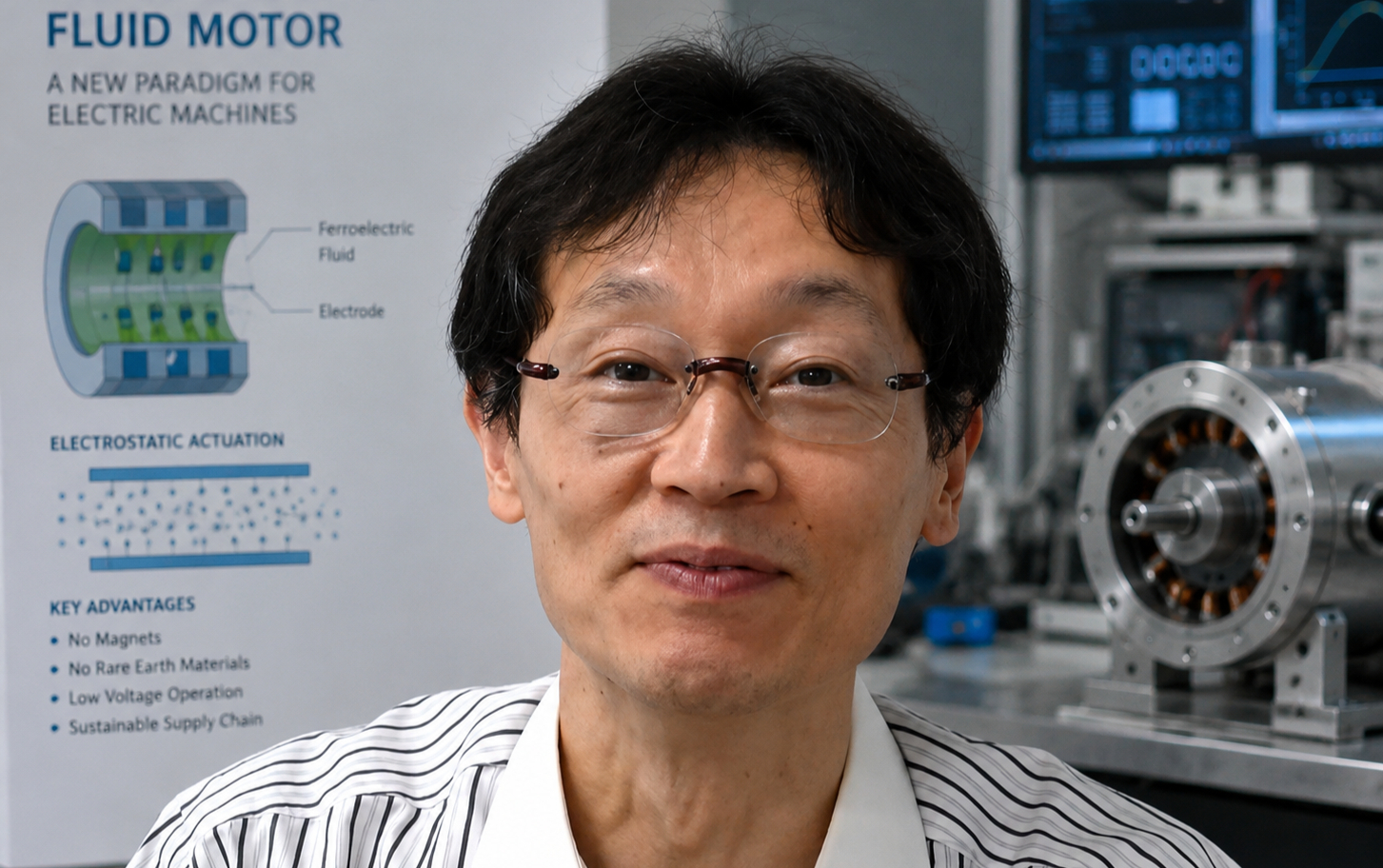
Suzushi Nishimura, Specially Appointed Professor at the Institute of Science Tokyo, explained the central design move in a written statement issued alongside the publication of the research: "By using a ferroelectric nematic liquid crystal whose dielectric constant and polarization are over a thousand times greater than those of conventional materials, we drastically reduced the required driving voltage, from around 10 kV to just a few tens of volts. Moreover, by harnessing the electrostatic force acting perpendicular to the applied electric field, we were able to construct a rotor made entirely of plastic." Nishimura framed the design as "lightweight, rare-earth metal-free, and sustainable."
Why the timing matters for industrial supply chains
The breakthrough lands as manufacturers continue to wrestle with concentration risk in critical mineral sourcing. The International Energy Agency reports that China accounts for roughly 60% of global rare earth mining and around 91% of processing capacity, and S&P Global Mobility data shows that approximately 94.7% of light electric vehicles in 2025 use motors dependent on rare earths. China's October 2025 export controls on heavy rare earths sharpened that exposure. A motor architecture that removes rare earths from the bill of materials, even if years from commercial scale, changes how procurement teams should be modeling 2028 to 2032 sourcing scenarios.
Visibility into upstream materials is now a procurement priority
The lesson for supply chain leaders is not that ferroelectric motors will replace permanent magnet machines in the next budget cycle. It is that material-level visibility into motor design is becoming a sourcing priority on its own. Scott Lehmann, VP Product Management at Sphera, an operational risk management and supply chain platform provider, captured the broader shift in a written response to The Supply Chainer's inquiry: "The Strait of Hormuz didn't create new supply chain risks. It made invisible ones visible. Multiple industries discovered they shared the same upstream dependencies. Leading enterprises are no longer starting their risk analysis from a supplier list. They're starting from their products, decomposing each product line through components and materials down to Tier 2 and Tier 3."
Operators remain cautious. Laboratory demonstrations rarely translate cleanly into industrial volume. Ferroelectric fluid motors still need to show torque density that approaches permanent magnet machines, sustained thermal stability, and a fluid chemistry stable enough for long duty cycles. Cost per unit at scale is unknown. Still, the directional signal is clear. Procurement teams that have been treating rare earth exposure as a fixed industrial constant should be tracking ferroelectric and other rare-earth-free motor architectures as part of their long-term sourcing strategy.

China Sends Cargo on First Regular Arctic Route to Europe, Challenging Traditional Supply Chains
Aug 17, 2026
Structured Intake Emerges as a Key Lever in Procurement Efficiency
Aug 16, 2026