

Container Ship Sunk in Black Sea Disrupts Cargo, Raises Supply Chain Concerns

A container ship sinking off Bulgaria creates a supply chain problem that extends beyond the cargo on board. Manufacturers may lose components needed to keep production running, distributors may have to replace committed stock, and freight forwarders may face customers seeking alternative routes simultaneously. The immediate exposure is concentrated among businesses using western Black Sea services. The wider concern is whether repeated attacks make those services less predictable, forcing companies to reconsider how much inventory and transport flexibility they need.
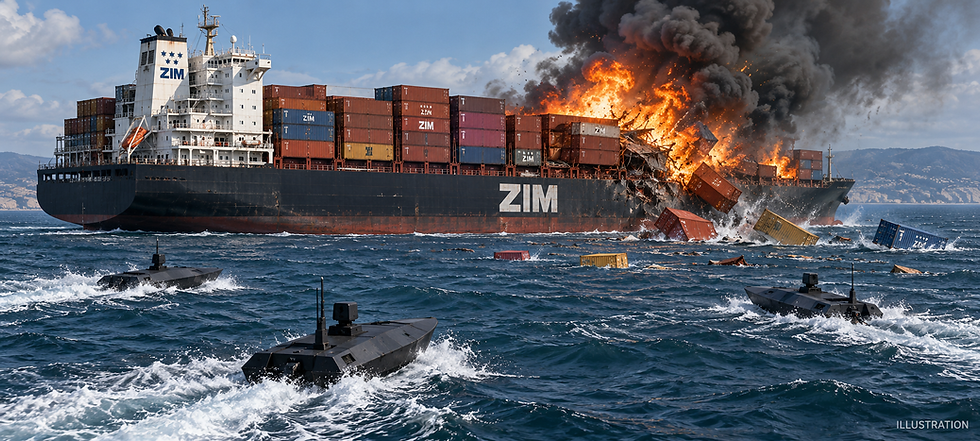
The Contship Jet sank after an October 28 attack involving three maritime drones while sailing toward Constanța, Romania. Bulgarian transport authorities said the vessel carried 421 containers and confirmed that all 18 crew members were rescued. The identity of the attacker had not been established in the reporting available on October 29. The incident demonstrates exposure along a commercial approach to a European gateway, without establishing that the port itself has become unavailable.
The Most Exposed Companies May Be Waiting for One Component
The businesses with the most to worry about are those whose operational dependence exceeds the financial value of their shipment. A relatively inexpensive component can interrupt production if no approved substitute is available. Replacing its purchase value would not, by itself, restore the manufacturing schedule or fulfil customer commitments. For those companies, the critical measures are days of usable stock, replacement lead time and the availability of qualified alternatives.
Importers using Constanța or other Black Sea gateways also need to distinguish supplier diversity from transport diversity. Purchasing from several suppliers provides limited protection if their goods converge on the same vessel, feeder service or port approach. A procurement dashboard may show multiple sources while the physical supply chain retains a single point of failure. Mapping that shared dependency is more useful than counting suppliers alone.
A Replacement Vessel Does Not Replace Lost Inventory
Carrier recovery and customer recovery follow different timelines. Restoring a sailing can help subsequent shipments, but cargo already lost requires replacement production, another booking and a revised delivery plan. Even where replacement goods are available, businesses may have to compete for earlier departures or more expensive transport. The commercial consequences therefore depend on the cargo’s role in the receiving operation, rather than the carrier’s ability to resume service alone.
The vessel was operating under charter to ZIM and had departed Haifa, Israel. In its response to Ynet, the company said it was seeking a replacement vessel and initially expected minimal financial damage to itself. That assessment concerns the carrier’s exposure; it does not establish the losses or recovery times facing individual cargo owners. The distinction matters whenever a reassuring corporate statement is used to assess a customer’s inventory position.
Alternative Routes Move the Constraint Elsewhere
For affected shippers, a Mediterranean gateway followed by inland transport is a potential contingency to evaluate. Its usefulness depends on the shipment’s origin, destination, cargo characteristics and available connections. Additional handling, road or rail capacity, equipment availability and delivery appointments can change both the cost and the timing. A route that avoids the immediate maritime threat may still fail to deliver goods when production needs them.
Freight forwarders and logistics providers face a related exposure if several customers activate contingency plans together. An alternative routing proposal has limited operational value until capacity, inland connections and receiving arrangements are confirmed. If rerouting concentrates demand at another gateway, the disruption can move from the sea leg to terminals, trucking or warehouse intake. This is a possible consequence of a broader service response, rather than evidence that such congestion has already occurred.
Insurance Recovery and Operational Recovery Are Separate
Cargo owners and finance teams need a shipment-specific understanding of insurance, contractual responsibility and the documentation required after a loss. The relevant questions include whether the applicable cover responds to the event, which losses fall within its terms and what evidence is needed to support a claim. Those answers cannot be inferred from the vessel’s flag, the carrier’s name or a general statement that cargo is insured. Any resulting payment must also be distinguished from the cash needed immediately to purchase and transport replacement stock.
The operational concern extends to logistics purchasing decisions for future shipments. Any change in insurance terms, carrier acceptance or sailing availability could alter the economics of a route, but the attack alone does not establish that premiums have risen or services have been suspended. Procurement teams need current quotations and confirmed operating conditions before incorporating those effects into landed-cost models. Treating an anticipated surcharge as an established market fact would distort the comparison.
The Warning Is About Reliability, Not a Proven Port Closure
The International Maritime Organization had already warned in September that attacks on merchant shipping were affecting supply chains across several conflict zones. Its Secretary-General, Arsenio Dominguez, said: “Do not use these conflicts to attack innocent seafarers.” For supply chain leaders, crew safety is the immediate concern, while service continuity determines how the consequences reach factories, distributors and customers.
The most vulnerable businesses combine low inventory cover, difficult-to-replace products and dependence on a narrow transport corridor. Companies with qualified substitutes, accessible stock and workable alternative routes have more room to absorb a disruption. The decision now is whether existing delivery commitments remain credible under a delayed or cancelled sailing. A confirmed cargo loss requires immediate recovery; wider changes to inventory and routing should follow verified changes in service


