

Autonomous Logistics Meets the Reality of Existing Facilities

Autonomous vehicles enter facilities whose operating conditions were rarely designed around them. Floors vary, manually driven vehicles share routes, and material must arrive at equipment with enough precision to keep production moving. Retrofitting an existing vehicle adds another question: whether its condition and configuration make conversion practical. The commercial case depends on how those constraints are handled throughout the workflow, beyond the vehicle’s ability to complete an isolated movement.
A retrofit starts with the vehicle and its working environment
Joe Foster, Vice President of Robotics at Holman, described a customer-specific assessment process for the company’s partnership with ISEE. The initial application is repetitive trailer movement in environments such as distribution centers and manufacturing facilities. That gives the partnership a defined operating task, but it does not make every vehicle or yard equally suitable. In its response, Holman did not provide a deployment timetable or identify an initial customer.
“As customers look to enhance existing yard vehicles with autonomous technology, Holman and ISEE will assess both the condition and configuration of their current yard trucks as well as the customer’s specific operating environment to determine which units may be a good candidate to be upgraded,” Foster said in written responses to The Supply Chainer. “The goal of the Holman and ISEE partnership is to simplify that process and offer customers a faster path to deploying autonomy without necessarily incurring the significant capital investment. As Holman and ISEE work closely with each customer to deploy autonomous solutions, we’ll focus on the metrics that matter most to that specific customer, including safety, productivity, utilization, reliability, and overall economics.” Those categories establish the scope of evaluation, although the response did not specify numerical performance thresholds.
The factory floor exposes the integration requirements
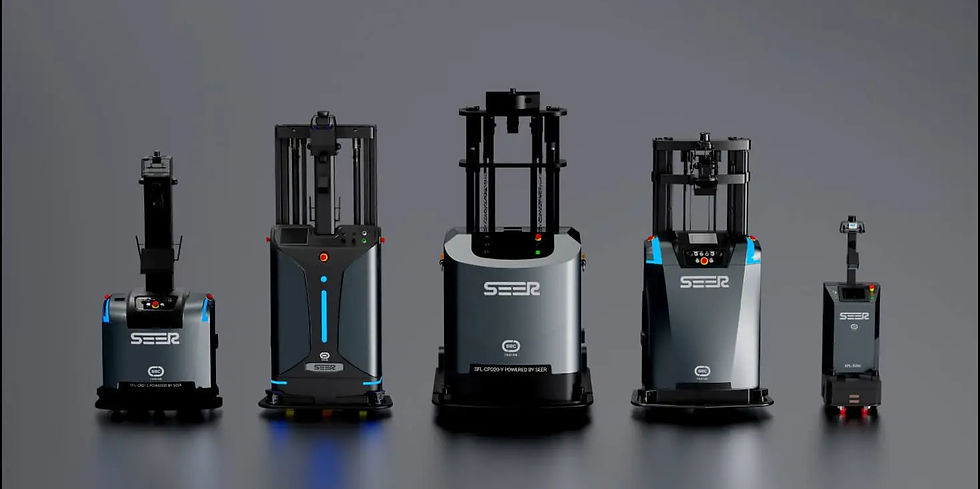
Miya Gong, Head of Global Marketing at SEER Robotics, supplied a manufacturing example involving Schneider Electric in the United States. According to Gong, autonomous forklifts move finished goods while operating around uneven floors and manually driven forklifts. The deployment also requires precise pallet docking at roller conveyor production lines. Those details describe a system that must coordinate with an existing operation, rather than simply navigate between two locations.
“One example is Schneider Electric, which has deployed SEER Robotics’ autonomous forklifts to its U.S. manufacturing facility to automate finished-goods transportation,” Gong said in written responses to The Supply Chainer. “The project involved several practical challenges, including uneven floors, mixed traffic between autonomous and manually operated forklifts, and precise docking with pallets at roller conveyor production lines. SEER Robotics addressed these requirements through laser SLAM navigation, optimized obstacle avoidance, customized pallet docking, and integration with the factory’s production logistics system. The solution enables automated material transfers synchronized with production workflows, reducing manual handling and improving warehouse transportation efficiency within the existing facility.”
SEER says its Robot Brain technology powers more than 50,000 robots worldwide. That company-reported figure describes the technology’s installed reach, rather than the measured performance of the Schneider Electric application. Gong did not provide before-and-after throughput, intervention rates, availability or financial savings for that deployment. The example therefore illustrates implementation requirements without establishing a quantified return on investment.
Repeatability depends on what changes between sites
Mason Cole, Director of Sales, North America at Sereact, told The Supply Chainer in response to an earlier inquiry that a robotic platform needs a standardized core while accommodating differences in material presentation, station design, integrations and operator interaction. His comments concerned robotic picking across multiple fulfillment sites, rather than autonomous forklifts or yard trucks. The shared issue is how much engineering must be repeated whenever the operating environment changes. A platform’s ability to move between sites matters commercially only if those adaptations remain manageable.
For operators, the evaluation should connect movement performance with the work that follows it. A completed autonomous journey has limited value if a trailer waits for the next task or a pallet cannot transfer reliably to the production interface. Useful deployment evidence would therefore show sustained throughput, manual interventions and availability across representative shifts and operating conditions. Holman’s assessment framework and SEER’s manufacturing example identify relevant questions, while leaving customers to seek the operating data needed to judge scale and economics.

